Process Mapping Best Practices
Process mapping best practices help teams create clearer, more accurate maps that improve process discovery and support better analysis later on.



Process mapping best practices help teams create clearer, more accurate maps that improve process discovery and support better analysis later on.
Process mapping is one of the main techniques used during process discovery. It helps teams visualize how work moves across activities, roles, systems, and decisions.
However, not every process map is equally useful. Some maps look organized but fail to reflect how the process really works. Others include so much detail that they become hard to read, maintain, or use.
Best practices help avoid these mapping mistakes. They improve the quality of the map itself, but more importantly, they improve the quality of the discovery work behind it.
Strong process mapping is not just about drawing boxes and arrows. A useful map should reflect the current state, make handoffs and decisions visible, and help teams build a shared understanding of how work actually happens.
The principles below help teams create maps that are clear, reliable, and useful in process discovery and process mapping workshops.
A process map should be created for a reason. Teams often begin mapping because a process feels confusing or inefficient, but they do not always define what the map is supposed to help them achieve.
That creates problems quickly. A map built for training new employees will not need the same depth as one built for process analysis or automation. If the purpose is vague, the map often becomes too generic to support any real decision.
A clear purpose helps shape the entire mapping effort. It influences the scope, level of detail, stakeholder group, and format of the final map.
In practice, teams should be clear about whether they are mapping to:
When the purpose is defined early, the map becomes much more useful because it is built around a specific outcome.
One of the most important best practices is setting clear boundaries before mapping begins. Without a defined scope, process maps often become either too broad to manage or too narrow to explain the real problem.
A broad scope usually creates a map that includes too many teams, systems, and decision points in one view. This makes the map hard to follow and difficult to use. A narrow scope creates the opposite problem. It may document one part of the process well, but still miss the upstream or downstream handoffs that explain delays, rework, or confusion.
Good scoping starts with a clear start point and end point. It also requires agreement on which roles, systems, and subprocesses belong inside the map.
A well-scoped map helps teams:
Good process maps are rarely “complete” in one step. Strong teams define a manageable boundary first, then deepen the map only where more detail is needed.
In process discovery, the first job of process mapping is to show the as-is process. That sounds simple, but many teams move too quickly into discussions about how the process should work instead.
This weakens the value of the map. If the team captures the ideal flow instead of the actual one, the map may look clean and logical, but it will not explain the real causes of delay, confusion, or variation.
A strong current-state map includes what really happens in practice. That means it should capture workarounds, repeated checks, skipped steps, manual actions outside systems, and the most relevant exceptions.
This principle matters because later BPM activities depend on it. If the current state is inaccurate, then process analysis, redesign, and automation work will start from the wrong assumptions.
Teams that map the current state well usually:
A process map becomes more reliable when it reflects the knowledge of the people who actually perform the process. If mapping is done only by managers, analysts, or transformation leads, important parts of the workflow are often missed.
This happens because different stakeholders see different parts of the process. A manager may understand the intended design, while frontline participants know where work slows down, where manual steps happen, and which exceptions appear in real cases. Both perspectives matter, but they are not interchangeable.
Involving the right participants improves discovery quality. It helps teams move beyond the official process and capture how work is really carried out across roles, handoffs, and systems.
A strong stakeholder group usually helps uncover:
Good process mapping does not mean inviting everyone. It means including the people who can explain the process from the right angles and then validating the map with others where needed.
A process map should be easy to follow. That becomes harder when teams mix symbols, use inconsistent layout conventions, or label activities in vague ways.
Consistency improves readability. It helps different stakeholders understand the map quickly and reduces the risk that people interpret the same diagram in different ways. This is especially important when multiple teams create maps across the same BPM practice.
A good structure includes predictable flow direction, clear activity labels, visible roles, tasks, events, and consistent decision points. Teams do not need perfect notation from the start, but they do need shared rules.
Useful practices include:
This does not make the map more formal for its own sake. It makes the map easier to use, easier to review, and easier to maintain over time.
One of the hardest process mapping decisions is knowing how much detail to include. If the map is too high-level, it may hide the handoffs, decisions, and issues that matter. If it is too detailed, it becomes difficult to read and maintain.
The right level of detail depends on the purpose of the map. A map used for stakeholder alignment should not look the same as a map used to support automation or root cause analysis. Trying to satisfy every use case in one diagram usually leads to a map that is too dense to be useful.
Strong maps include enough detail to explain the process and support the intended decision, but not so much that every step becomes operational noise.
A practical test is to ask whether each step in the map helps the reader understand the process or act on it. If not, that information may belong in notes, linked subprocesses, or supporting documentation instead of the main flow.
Teams usually get the level of detail right when they:
When the level of detail fits the purpose, the process map becomes much easier to use as part of process discovery.
Many process maps show activities clearly, but become harder to follow at the points where work changes direction or moves between teams. Those moments are often where delays, confusion, and rework begin.
A strong process map makes handoffs visible and decision points easy to understand. Readers should be able to see who takes over, what condition is being checked, and why the process follows one path instead of another.
This matters because unclear handoffs can hide ownership problems, and vague decision points can make the map look complete without actually explaining the flow.
Useful practices include:
For example, a decision point labeled “Invoice matches purchase order?” is much more useful than a diamond with no clear condition. In the same way, a handoff between procurement and finance should be visible, not implied.
When handoffs and logic are explicit, the map becomes easier to analyze and much more useful for process discovery.
A process map should not show only the happy path. In real organizations, processes often vary depending on customer type, geography, approval thresholds, missing data, or system behavior.
If those important variants are not included, the map may look simpler than the process actually is. That creates a false sense of clarity and weakens the value of the discovery work.
This does not mean every rare edge case needs to appear in the main diagram. The goal is to capture the exceptions and alternate paths that materially affect performance, quality, risk, or coordination.
Strong teams usually focus on variants such as:
Capturing key variants helps teams understand where the process behaves differently in practice. That makes the map more realistic and gives later analysis a stronger starting point.
If the number of variants becomes too large for one diagram, the best practice is to keep the main map readable and document important alternatives separately. That way, the process map remains useful without hiding the complexity that matters.
Process mapping is a strong discovery technique, but it does not answer every question on its own. It works best when the goal is to build a shared understanding of the process and make the main flow, roles, and decisions visible.
In more complex environments, that is sometimes only part of the picture. A process map can show how the process is understood, but not always how it actually runs across systems, how often variants occur, or where hidden manual work happens.
This is usually the point where teams need to complement mapping with other discovery techniques. In practice, these techniques are often supported by process intelligence tools, which help teams analyze real execution data at scale.
For example:
This does not reduce the value of process mapping. It shows where mapping fits best. In many BPM teams, process mapping provides the structure, while data-driven techniques add evidence and scale.
That is especially useful when:
In those cases, process mapping remains important, but it becomes stronger when combined with other discovery methods.
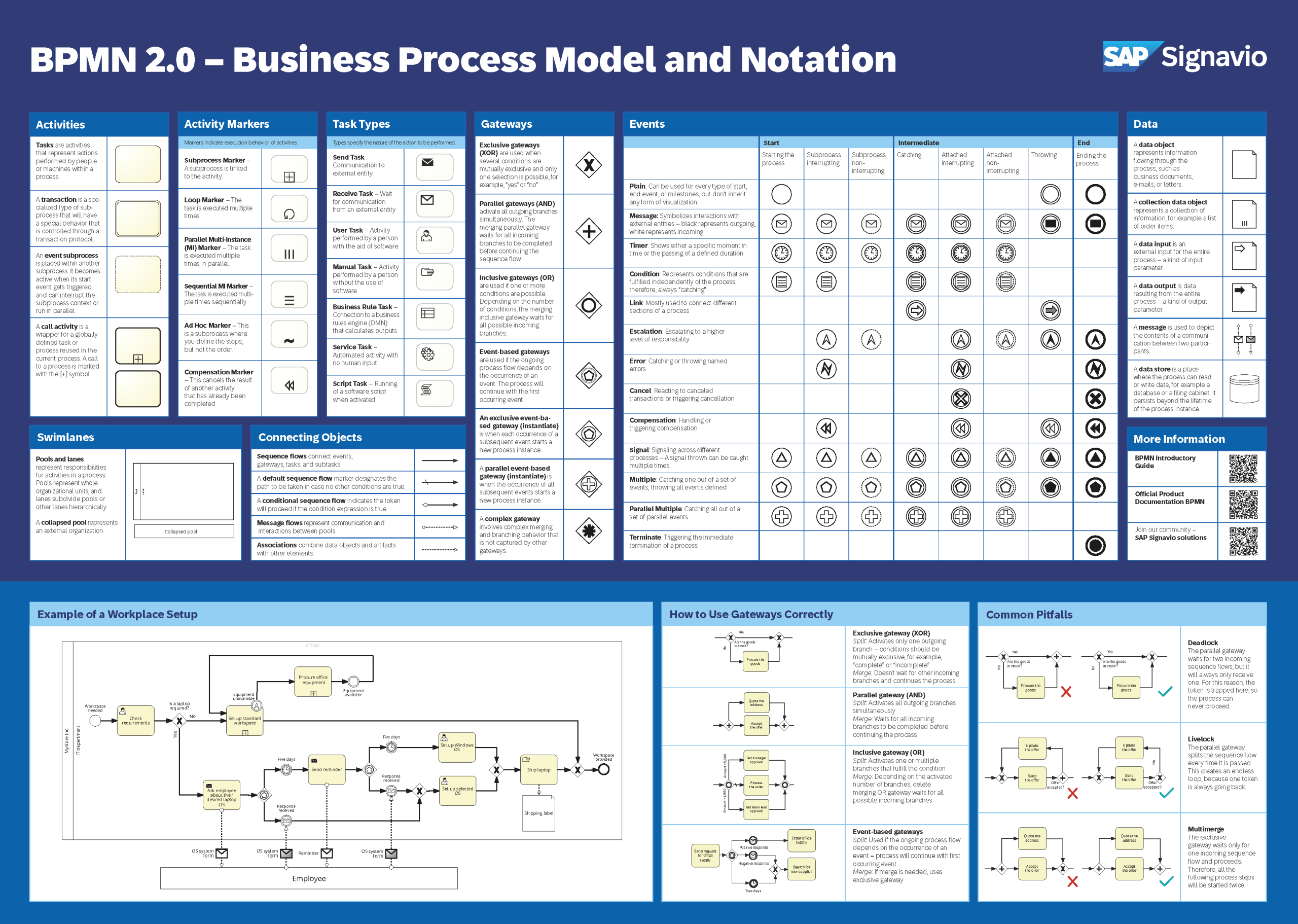
Get a BPMN 2.0 overview poster with the various graphical elements, examples of applications, and their meaning.