Automated Process Discovery
Automated process discovery uses data, software, and AI to map how processes run, helping organizations perform process discovery faster and with less manual effort.



Automated process discovery uses data, software, and AI to map how processes run, helping organizations perform process discovery faster and with less manual effort.
Many organizations start process discovery with workshops and manual process mapping. These approaches help align teams, but they can be slow and based on assumptions.
In practice, processes run across multiple systems and often behave differently than expected.
Automated process discovery uses system data and software to show how processes actually run. Event logs from systems such as ERP or CRM reveal real execution, not just documented flows.
AI is increasingly used to support this approach by identifying patterns, grouping variants, and detecting anomalies in large datasets.
Automated process discovery is not a separate step in BPM. It is a way to perform the process discovery stage faster and with more accurate insights.
Automated process discovery uses data, software, and AI to identify and map how a business process actually runs, helping organizations move beyond manual documentation.
In the market, this concept was often referred to as automated business process discovery (ABPD). Today, it is increasingly delivered through process intelligence platforms, which combine data analysis, AI, and process technologies to understand how processes run across systems and user interactions.
Within the BPM lifecycle, automated process discovery belongs to the process discovery stage. Its goal is the same as manual discovery—to understand the current state of a process—but the approach is different.
Instead of relying only on process mapping through workshops or interviews, automated discovery uses:
For example, a company analyzing its procure-to-pay process may traditionally rely on workshops to map how invoices are processed. With automated process discovery, the organization can analyze system data to see:
AI further supports this by identifying patterns across large datasets and highlighting areas that require attention.
This creates a more accurate picture of how the process runs in reality.
Automated process discovery does not replace manual methods. Workshops and expert input are still needed to understand business context, decisions, and exceptions.
Instead, automation complements manual discovery by providing objective insights based on real operational data.
In more advanced setups, AI agents can continuously monitor processes and trigger actions based on discovered patterns.
Automated process discovery is increasingly supported by a new category of tools known as process intelligence platforms.
These tools combine multiple technologies to provide a data-driven view of how processes run across systems and user interactions.
Process intelligence tools bring together:
This combination allows organizations to understand processes end-to-end, instead of relying on isolated analysis.
Insights from automated process discovery are often used to identify automation opportunities, which can then be implemented using technologies such as robotic process automation (RPA).
SAP Signavio Process Intelligence supports automated process discovery by analyzing system data and generating process flows, variants, and performance insights.
→ Related: 2026 Gartner Magic Quadrant for Process Intelligence Tools
Some tools provide predefined analyses for common business processes. These allow organizations to quickly identify inefficiencies without building models from scratch.
They are often used as a starting point to gain fast visibility into standard processes such as procure-to-pay or order-to-cash.
SAP Signavio Process Insights enables automated process discovery by highlighting deviations, inefficiencies, and improvement opportunities based on predefined metrics.
Once processes are discovered, modeling and collaboration tools help document, validate, and share findings with stakeholders.
These tools ensure that insights from automated discovery are aligned with business context and maintained over time.
Automated process discovery changes how organizations understand their processes. Instead of relying on fragmented knowledge from workshops, teams can analyze real execution data and build a more complete and reliable view of how work happens.
This shift has several practical benefits.
Manual process discovery often requires multiple workshops, interviews, and iterations to map even a single process. This can take weeks or longer, especially when multiple teams are involved.
Automated process discovery reduces this effort by using system data to reconstruct process flows more quickly. Teams can move from initial exploration to a working process view in a much shorter time.
As a result, organizations can:
In manual discovery, processes are often described based on how they are expected to work. In reality, processes frequently include exceptions, workarounds, and variations that are not captured in documentation.
Automated process discovery uses real execution data, which provides a more objective view of how processes actually run.
This leads to:
Most processes do not follow a single, standard path. Instead, they include multiple variants depending on conditions, teams, or systems involved.
Automated process discovery makes these differences visible by analyzing large volumes of process data.
Organizations can identify:
These insights help teams focus on the areas that have the biggest impact on performance.
In many organizations, processes span multiple systems and involve thousands or millions of transactions. Mapping these processes manually is difficult and often incomplete.
Automated process discovery allows teams to analyze processes at scale by using system data.
This makes it possible to:
Manual process discovery is often a one-time activity. Once a process is documented, it may not be updated regularly, even as the process changes over time.
Automated process discovery can be repeated or run continuously using updated data. This allows organizations to maintain an up-to-date view of their processes.
This enables:
Process discovery is only the first step in the BPM lifecycle. The insights generated during this stage are used in process analysis, design, and optimization.
Automated process discovery provides a stronger foundation for these next steps by offering data-driven insights.
Organizations can use these insights to:
This makes automated process discovery a key enabler for both process improvement and digital transformation initiatives.
Using data-driven approaches to understand processes brings clear benefits, but it also introduces practical challenges. These often relate to data, interpretation, and how BPM teams work with new tools.
The insights generated depend heavily on the quality and completeness of system data. If key data points are missing or inconsistent, the resulting process view may not reflect reality.
For example, missing timestamps or inconsistent case identifiers can make it difficult to reconstruct accurate process flows.
Organizations may face challenges such as:
Data shows how processes run, but it does not always explain why they run that way.
While patterns, delays, and deviations are visible, business rules, decisions, and exceptions are often not captured in system data.
This means teams still need human input to:
Many processes span several systems, such as ERP, CRM, and custom applications. To get a complete picture, data from these systems needs to be combined and aligned.
This can be technically complex and requires effort to ensure consistency.
Common challenges include:
Data-driven discovery can produce a large number of process variants and performance metrics. Without clear focus, it can be difficult to identify what matters most.
For example, a process may have dozens of variants, but only a few significantly impact performance.
BPM teams need to:
Moving from manual methods to data-driven discovery changes how teams approach process work. Not all stakeholders are familiar with interpreting process data or trusting system-based insights.
Adoption requires both technical enablement and organizational alignment.
Organizations may need to:
To understand how automated discovery works in practice, consider a procure-to-pay process. This process typically spans multiple systems, involves several approval steps, and includes both automated and manual activities.
It is a good example because it often looks simple on paper, but becomes complex in reality once different departments and exceptions are involved.
The finance and procurement teams begin with workshops to map how the process is supposed to work. Stakeholders from accounting, purchasing, and operations describe each step based on their experience.
At this stage, the goal is to build a shared understanding of the process structure and responsibilities. The team agrees on a standard flow that represents the intended process.
This usually includes steps such as:
This creates a structured process map that helps align stakeholders.
However, even during these discussions, differences start to appear. Teams describe variations in how work is handled, and certain exceptions are only partially documented or not captured at all.
To validate and expand this view, the organization mines process and analyzes event logs from its ERP system using process intelligence tools.
Instead of relying on a single documented flow, the team can now observe how the process actually behaves across thousands of real transactions.
This shift from assumptions to data reveals patterns that are not visible in workshops alone. It becomes clear that the process does not follow one consistent path.
For example, the data shows that:
This comparison highlights the gap between how the process is described and how it actually runs.
With execution data available, the team can start analyzing performance across the process.
Instead of asking where delays might occur, they can measure exactly where time is spent and how often issues happen. This allows for a more focused and objective discussion.
The analysis shows that:
These insights help the team move from general assumptions to specific, measurable problems.
While system data explains process flows, it does not always show everything that happens during execution.
To gain a more complete picture, the organization looks at user interactions through task mining. This helps uncover manual activities that are not recorded in system event logs.
The team discovers that:
These activities explain why certain steps take longer than expected and why delays cannot be fully understood from system data alone.
At this point, the team is dealing with a large amount of process data, including many variants and edge cases. Reviewing all of this manually would take significant time and effort.
AI helps by structuring and prioritizing the information, so teams can focus on the most relevant insights.
Instead of analyzing every possible path, AI can:
For example, AI may show that most delays are not random, but linked to a specific approval step or supplier group.
This allows teams to shift from exploring data to making decisions based on it.
AI can also support the next step by enabling AI agents that act on process insights. For example, an agent can monitor process execution, detect delays or deviations in real time, and trigger actions such as notifications, escalations, or automated corrections.
By combining workshops, system data, and AI-supported analysis, the organization builds a more complete and reliable understanding of the process.
Each method contributes a different perspective. Workshops provide structure and context, system data shows actual execution, and AI helps interpret complex patterns.
As a result, the team can:
This leads to concrete actions such as:
This example shows how automated discovery moves organizations from a simplified, workshop-based view to a data-driven understanding of how work actually happens, while still relying on human input to interpret and validate the findings.
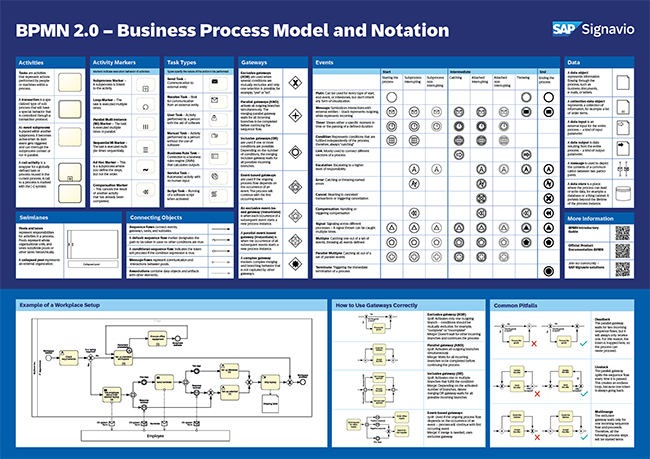
Get a BPMN 2.0 overview poster with the various graphical elements, examples of applications, and their meaning.