Business Process Management Examples

Business process management examples show how BPM is applied in real organizations. This page explains common BPM workflows by function and industry and illustrates how BPM supports practical, repeatable process improvement.

A Practical, Detailed, and Convenient Guide for Designing Optimal Business Processes_en.png

If you are exploring business process management, examples help you understand how BPM is applied in real organizations. They show where BPM typically starts, which workflows are addressed first, and what kinds of improvements teams focus on in practice.

On this page, you will find BPM examples grouped by business functions, such as finance, HR, customer service, or operations. This reflects how most organizations manage ownership and accountability.

Within each function, specific workflow examples are called out to make it clear which processes are being improved, such as employee onboarding, invoice processing, or customer request handling.

Each example explains:

  • which workflow is involved,
  • what problems teams are trying to solve,
  • how BPM is applied in that context,
  • and what types of outcomes organizations usually achieve.

You can use these examples to compare them with your own situation, identify similar challenges, and understand how BPM supports your overall business process management strategy in practice.

The 10-Step Guide to Achieving Process and Experience Excellence_preview_en

10-Step Guide to Achieving Process and Experience Excellence

All businesses have the same goal: to run at their best. But all too often, there’s a disconnect between operations and experience. What’s missing is an outside-in perspective on operational excellence and transformation efforts. This can help you drive a differentiating edge in the market and ongoing financial success.
Download now

Business process management examples by function

1. Finance and accounting processes

Typical workflow example: procure-to-pay or order-to-cash

Finance and accounting processes are often among the first areas where BPM is applied. These workflows involve multiple handoffs, approvals, and systems, and even small inefficiencies can create delays, errors, or compliance risks.
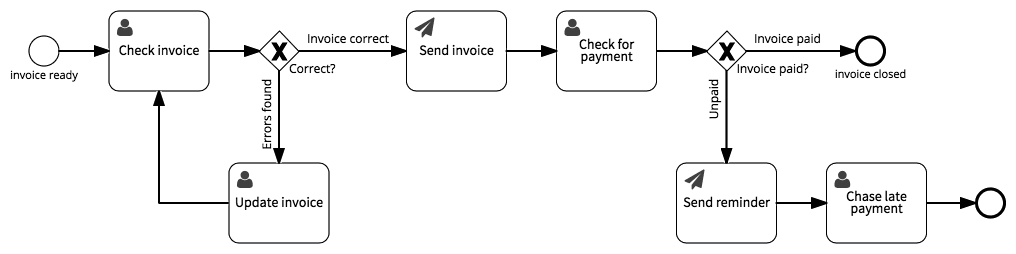
Invoice customer workflow example

You typically see BPM used here when teams struggle with inconsistent execution, unclear ownership, or limited visibility into where transactions get stuck. BPM helps by making the end-to-end workflow explicit, defining responsibilities, and creating a shared view of how finance processes are supposed to run.

In a procure-to-pay workflow, for example, BPM is applied to standardize how purchase requests are created, approved, processed, and reconciled. This reduces manual rework, shortens cycle times, and improves transparency across procurement, finance, and operations. In an order-to-cash workflow, BPM often focuses on reducing delays between order creation, invoicing, and payment collection.

These finance BPM examples usually lead to:

  • clearer ownership across finance and procurement,
  • fewer manual workarounds,
  • more predictable processing times,
  • and better visibility into financial operations.

DKB Service shows how BPM was applied to improve finance-related service processes and increase transparency across teams.

2. Human resources and people processes

Typical workflow example: employee onboarding

Human resources processes are another common starting point for BPM, especially in growing or distributed organizations. Workflows such as employee onboarding often involve many handoffs between HR, IT, facilities, managers, and external providers, which makes coordination difficult without clear process ownership.
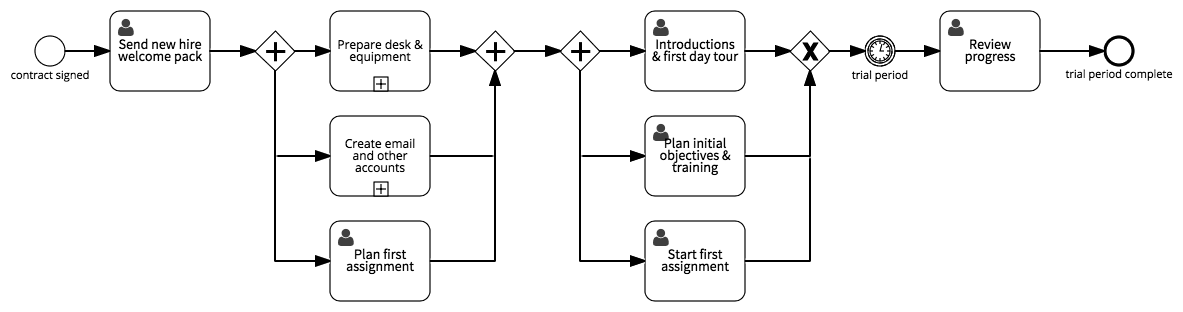
Employee onboarding workflow example

You usually see BPM applied when onboarding experiences vary across teams or locations, when responsibilities are unclear, or when new hires are not productive on time due to missing access, equipment, or information. BPM helps by defining a single end-to-end onboarding workflow that makes dependencies visible and responsibilities explicit.

In an employee onboarding workflow, BPM is used to standardize how hiring information is passed from HR to other teams, when system access is provisioned, and how tasks are tracked before and after a new employee’s first day. This creates consistency while still allowing local or role-based variations where needed.

These HR BPM examples typically result in:

  • clearer ownership across HR and support teams,
  • more predictable onboarding timelines,
  • fewer manual follow-ups,
  • and a more consistent experience for new employees.

NSW Department of Education demonstrates how BPM supported the management and standardization of large-scale people and administrative processes.

3. Customer service and case management

Typical workflow example: customer request or claims handling

Customer service processes are often highly visible and directly impact customer satisfaction. These workflows usually span multiple teams and systems, making it difficult to maintain consistent response times and service quality without a clear process framework.
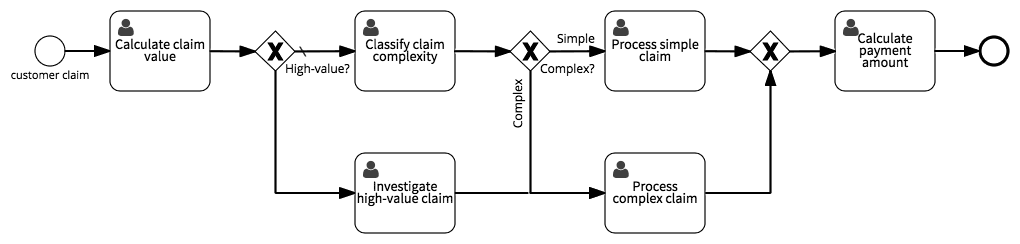
Process claim workflow example

You typically see BPM applied when customer requests are handled differently depending on the team, when cases are handed off without clear ownership, or when service-level agreements are difficult to meet or measure. BPM helps by making the end-to-end case flow explicit and by defining how work moves from intake to resolution.

In a customer request or claims handling workflow, BPM is used to standardize intake, triage, investigation, and resolution steps. It clarifies who owns each stage, how exceptions are handled, and how performance is tracked. This improves coordination between front-office and back-office teams and reduces delays caused by unclear handoffs.

These customer service BPM examples often lead to:

  • more consistent service levels,
  • improved visibility into case status,
  • clearer accountability across teams,
  • and better data for service improvement.

Ageas UK shows how BPM was applied to improve customer-facing processes and coordination across teams.

4. Supply chain and operations

Typical workflow example: procure-to-deliver or logistics coordination

Supply chain and operational processes are common BPM candidates because they span many teams, systems, and external partners. Even small inefficiencies can ripple across planning, procurement, warehousing, and delivery.
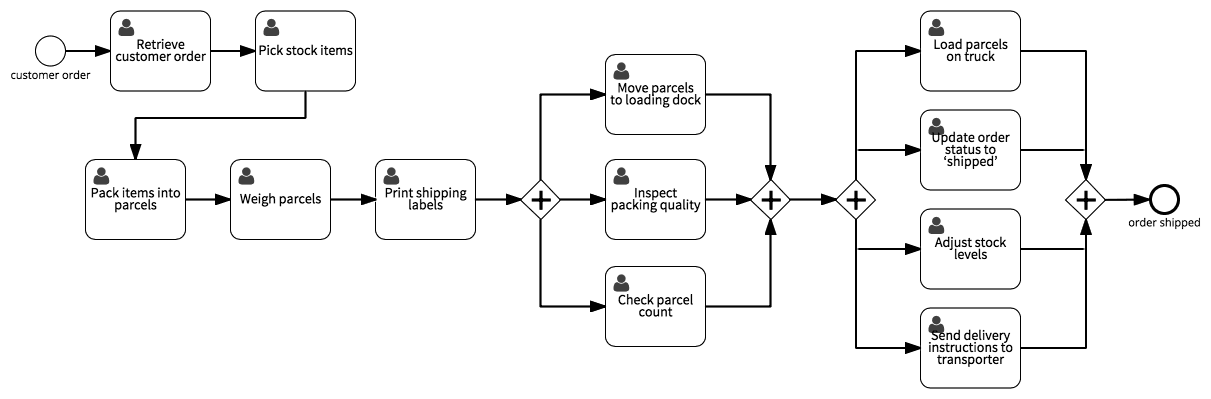
Ship product from warehouse workflow example

You typically see BPM applied when handoffs between functions are unclear, when delays are hard to trace, or when teams lack a shared view of how operational work flows end to end. BPM helps by making dependencies visible, defining ownership across stages, and aligning execution across internal and external parties.

In a procure-to-deliver or logistics coordination workflow, BPM is used to standardize how demand is translated into orders, how suppliers and internal teams are coordinated, and how exceptions are handled. This improves predictability and reduces the effort spent on manual follow-ups and escalations.

These supply chain BPM examples usually result in:

  • better coordination across operational teams,
  • fewer delays caused by unclear handoffs,
  • improved transparency across the supply chain, and more reliable execution.

Ocean Network Express illustrates how BPM supported coordination and transparency in complex, global operational processes.

5. Manufacturing and quality management

Typical workflow example: production quality control or change management

Manufacturing and quality management processes often involve strict standards, multiple approvals, and close coordination between engineering, production, and quality teams. Variations in execution can lead to defects, delays, or compliance issues.

You typically see BPM applied when processes differ across plants or product lines, when quality checks are handled inconsistently, or when changes to production procedures are hard to communicate and control. BPM helps by defining clear workflows, responsibilities, and approval paths that can be reused and governed across locations.

In a production quality control or engineering change workflow, BPM is used to standardize how issues are reported, assessed, approved, and resolved. This creates transparency around decisions, reduces rework, and helps teams understand how changes affect downstream activities.

These manufacturing BPM examples often lead to:

  • more consistent quality processes across sites,
  • clearer governance for production changes,
  • reduced risk of non-compliance,
  • and better coordination between engineering and operations.

Diehl Aviation shows how BPM supported standardized and governed processes in a highly regulated manufacturing environment.

Yamaha Motors illustrates BPM usage across complex manufacturing operations.

BPM Resources

Unlock hidden value in your business processes
Explore the results of our 'value challenge' initiative that demonstrates the hidden value organizations can uncover in their business processes by using BPM solutions.
A Practical Guide for Designing Optimal Business Processes
A modeling guidelines to help you create processes in a uniform way and present them comprehensibly for your whole team.
Process Mapping Basics
Find out how to get started with process mapping, and how to introduce business process management (BPM) concepts to your organization.
A Comprehensive Guide to Process Mining
Learn what process mining is, the value it offers, and why now is the right time to launch your own process mining initiative.

Business process management examples by industry

1. Healthcare and regulated environments

Typical workflow example: patient intake or clinical support processes

Healthcare and other regulated environments often rely on complex processes that must balance efficiency with strict compliance and quality requirements. These workflows usually involve many roles, formal approvals, and detailed documentation, which makes informal process management risky.

You typically see BPM applied when processes are difficult to standardize across departments or locations, when compliance requirements increase, or when teams struggle to keep documentation aligned with actual practice. BPM helps by creating clear, governed workflows that make responsibilities, controls, and exceptions explicit.

In a patient intake or clinical support workflow, BPM is used to standardize how information is collected, validated, and handed off between administrative and clinical teams. This improves coordination, reduces errors, and supports auditability without slowing down care delivery.

These healthcare BPM examples often result in:

  • clearer process ownership across departments,
  • improved compliance and traceability,
  • more consistent execution,
  • and better visibility into operational performance.

Hirslanden demonstrates how BPM supported structured and compliant process management in a healthcare environment.

2. Industrial and engineering organizations

Typical workflow example: engineering change or service operations processes

Industrial and engineering organizations often run highly specialized processes that span engineering, operations, quality, and service teams. These workflows are usually well defined on paper but difficult to execute consistently across locations, products, or projects.

You typically see BPM applied when process variations grow over time, when engineering changes are hard to communicate and control, or when operational teams lack a shared view of responsibilities and dependencies. BPM helps by creating a common process language and by governing how changes are introduced and executed.

In an engineering change or service operations workflow, BPM is used to standardize how requests are submitted, reviewed, approved, and implemented. This reduces misalignment between teams, improves traceability, and makes the impact of changes easier to understand.

These industrial BPM examples often lead to:

  • better coordination between engineering and operations,
  • clearer approval and change paths,
  • reduced rework and delays,
  • and improved transparency across complex processes.

Endress+Hauser shows how BPM supported the standardization and governance of complex industrial processes across the organization.

3. Enterprise-wide continuous improvement

Typical workflow example: cross-process improvement and governance cycles

In large organizations, BPM is often applied beyond individual workflows to support continuous improvement across many processes. The challenge is no longer documenting or fixing a single process, but creating a consistent way to manage, prioritize, and improve processes at scale.

You typically see BPM applied at this level when improvement initiatives are fragmented, when different teams use different standards, or when leadership lacks visibility into how processes perform across the organization. BPM helps by providing a shared structure for process ownership, performance tracking, and improvement cycles.

In an enterprise-wide continuous improvement workflow, BPM is used to standardize how processes are identified for improvement, how changes are evaluated and approved, and how results are monitored over time. This allows organizations to move from isolated optimization efforts to a coordinated BPM practice.

These enterprise BPM examples often lead to:

  • stronger alignment between process improvement and business priorities,
  • consistent governance across departments,
  • better reuse of standards and best practices,
  • and sustained improvement over time.

Aristocrat shows how BPM supported a structured, organization-wide continuous improvement approach.

BHP demonstrates how BPM enabled large-scale process governance and improvement across a complex enterprise.

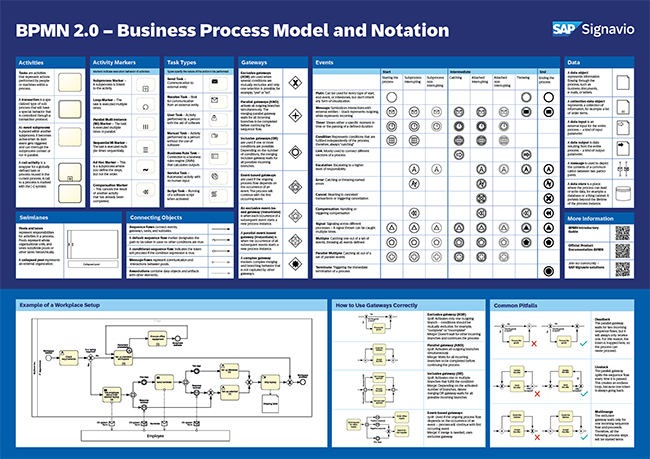
BPMN 2.0 poster
The uniform documentation of processes is vital for all organizations to provide a clear definition of responsibilities and manage key data in a structured manner. Our BPMN 2.0 poster offers daily support to document processes transparently, to avoid misunderstandings and to sustainably improve processes.

Business process management notation examples

Process notation is used in BPM to create a shared and unambiguous view of how work flows across roles, systems, and decisions. Notation does not exist for documentation alone. Its purpose is to help people understand processes, discuss improvements, and govern change consistently.

The most commonly used notation in BPM is BPMN (Business Process Model and Notation). BPMN provides a standardized way to represent activities, decisions, handoffs, and exceptions in a process.

Why notation matters in practice

Without a shared notation, process documentation often becomes ambiguous. Different teams may interpret the same diagram differently, leading to inconsistent execution and misunderstandings during improvement discussions.

Using BPMN helps you:

  • clearly separate activities, decisions, and events,
  • make handoffs between roles and systems explicit,
  • document exceptions instead of hiding them in text,
  • compare current-state and future-state processes objectively.

Notation becomes especially valuable when processes cross departments or need to be governed over time.

Example: before and after process notation

Consider a simple workflow such as employee onboarding.

Before BPM is applied, onboarding is often described informally, using text documents or high-level flowcharts. Important details—such as when IT access is triggered or who approves exceptions—are unclear or handled differently by each team.

Employee onboarding workflow example

After BPM is applied, BPMN is used to model the onboarding workflow explicitly. Roles are represented as lanes, decisions are modeled as gateways, and system-triggered steps are clearly distinguished from manual activities. This makes dependencies and delays visible and creates a clear reference for improvement.

The same approach applies to workflows such as invoice processing, customer request handling, or engineering change management.

How notation supports collaboration and governance

BPM notation creates a common language between business and technical teams. It allows process owners, analysts, and operational staff to review and discuss processes without relying on system-specific terminology.

In governance scenarios, BPMN helps ensure that changes are reviewed consistently and that approved process versions are clearly distinguishable from outdated ones. This reduces the risk of uncontrolled process drift.

Endress+Hauser illustrates how standardized process modeling and notation supported clarity, governance, and alignment across complex industrial processes.


What these BPM examples show in practice

Across functions and industries, BPM examples tend to follow similar patterns. Organizations usually start by addressing workflows that are hard to manage informally, involve multiple handoffs, or have a direct impact on efficiency, quality, or customer experience.

These examples show that BPM is rarely about redesigning everything at once. Instead, teams focus on a small number of critical workflows, clarify ownership, and make process behavior visible before introducing more advanced capabilities. BPM creates value when it brings structure, shared understanding, and consistency to everyday work.

Another common theme is that successful BPM examples connect process work to broader goals. Whether the focus is compliance, service quality, or operational efficiency, BPM supports these objectives by making processes measurable and governable rather than relying on individual effort.

Taken together, these examples illustrate how BPM moves from concept to practice. They show how BPM supports strategy by enabling repeatable improvements across different parts of the organization.

A Practical Way to Build Your Optimal Business Processes

Get the most important standards, ready for you to modify and adapt according to your own organizational needs.

Frequently Asked Questions

What are the most common business process management examples?

Common BPM examples include workflows such as employee onboarding, invoice processing, customer service case handling, supply chain coordination, and quality management. These processes benefit from BPM because they involve multiple roles, systems, and handoffs.

How do business process management examples support BPM strategy?

Are BPM examples different for small and large organizations?

Do BPM examples always involve automation?

How should I use these BPM examples in my organization?