Process Mapping Mistakes
Process mapping mistakes can reduce clarity, hide process issues, and weaken process discovery. Avoiding them helps teams create maps that support real improvement.



Process mapping mistakes can reduce clarity, hide process issues, and weaken process discovery. Avoiding them helps teams create maps that support real improvement.
Process mapping is one of the most common techniques used during the process discovery stage. It helps teams visualize how work flows across activities, roles, systems, and decisions.
However, the value of process mapping depends on how well it is done. When teams make avoidable mistakes, the map may look complete but still fail to support analysis, alignment, or improvement.
Some mistakes happen early, such as unclear scope or the wrong stakeholder group. Others appear later, when teams make maps too detailed, ignore real exceptions, or fail to maintain them over time.
The sections below cover the most common process mapping mistakes, how to fix them, and what strong BPM teams do differently.
Process mapping mistakes do not all happen at the same level. Some are strategic, some happen during discovery workshops, and others affect the quality and long-term use of the process map itself.
Not every organization will face all of them at once. Still, these patterns appear often enough that they are worth addressing directly.
One of the most common mistakes is beginning a process mapping effort without agreeing on why the business process is being mapped in the first place.
Teams often know that a process feels slow, confusing, or inconsistent, so they schedule workshops and start drawing flows. But if the purpose is unclear, the resulting map usually becomes too generic to support any real decision.
A process map created for onboarding and training will not need the same level of detail as one created to support automation or root cause analysis. When the intended outcome is not defined up front, teams may spend time documenting information that is not useful, while missing what actually matters.
How to fix it?
Before mapping starts, define the purpose of the map clearly. Decide whether the goal is to improve stakeholder alignment, support process analysis, prepare for automation, document compliance, or train new employees.
This helps the team decide:
What high-performance teams do?
High-performing teams do not treat process maps as general documentation. They define the audience, intended use, and expected outcome before the first workshop starts.
They know that a process map is not the end result. It is a tool that should help the organization make better decisions about the process.
Another frequent mistake is setting a process scope that is either too broad or too narrow.
If the scope is too broad, the map becomes difficult to manage and hard to understand. Teams try to capture too many activities, roles, systems, and exceptions in a single view. The result is often a complicated map that few people actually use.
If the scope is too narrow, the map may miss the handoffs and dependencies that explain why the process works the way it does. Teams may document one part of the process well, but still fail to understand the end-to-end flow.
This usually happens when start and end points are not defined clearly, or when the team jumps into mapping before agreeing on what the process includes.
How to fix it?
Define the process boundary before the mapping exercise begins. Be explicit about where the process starts, where it ends, and which activities belong inside or outside the scope.
A useful way to test the scope is to ask whether the map will help explain the issue the team is trying to solve. If not, the scope is probably wrong.
Teams should also clarify:
What high-performance teams do?
Strong teams choose a scope that is fit for purpose. They avoid trying to map an entire business capability in one workshop, but they also avoid reducing the process so much that key handoffs disappear.
They often start with a manageable boundary, then expand or deepen the map only where additional detail is needed.
A process map is only as useful as the knowledge behind it. If the wrong people are involved, the map will likely miss important steps, decisions, and real-world variations.
This mistake often happens when mapping is done by a small group of managers, analysts, or transformation leads without involving the people who actually perform the work. These participants may understand the intended design of the process, but not the daily reality.
As a result, the map may overlook:
In some cases, one team dominates the discussion and the process ends up reflecting only one part of the workflow.
How to fix it?
Include the people who know the process from different angles. This usually means combining process owners, frontline participants, analysts, and stakeholders from connected teams.
The goal is not to invite everyone, but to make sure the map reflects the full process rather than one viewpoint.
A good stakeholder mix helps uncover:
What high-performance teams do?
High-performing teams are intentional about stakeholder selection. They involve the people who perform the work, not just the people who govern it.
They also make sure no single perspective defines the whole process. When needed, they validate the map with additional participants after the workshop to confirm that the documented flow reflects reality.
This is one of the most important mistakes during discovery. Teams often describe how the process is supposed to work, especially if managers or process owners lead the discussion. The result is a clean and logical map, but not an accurate one.
That may look useful at first, but it creates problems later. If the process map shows the intended design instead of the real flow, teams will miss the actual causes of delay, rework, confusion, or non-compliance.
This mistake is common when organizations are already thinking about improvement before they have fully understood the current state. Instead of documenting what people really do, they start documenting what they want people to do.
How to fix it?
Keep the first map focused on the as-is process. Ask participants to describe what happens today, including workarounds, repeated checks, skipped steps, and manual interventions.
Useful prompts include:
If improvement ideas come up during the session, capture them separately. Do not mix them into the current-state map.
What high-performance teams do?
Strong teams separate as-is and to-be thinking very clearly. They know that process mapping in discovery is meant to create a reliable view of current reality first.
They also validate the map against real examples, not just opinions. In more mature environments, they often compare the mapped process with evidence from process mining or task mining to confirm that the current-state view is accurate.
A process map becomes less useful when it sits at the wrong level of detail. Some maps stay so high-level that they do not support any meaningful analysis. Others become so detailed that they are difficult to read, maintain, or use.
When the map is too broad, important decisions, handoffs, and pain points disappear. The process may look simple, but only because the real complexity has been hidden.
When the map is too detailed, the opposite happens. The team tries to capture every click, exception, and instruction in a single diagram. This usually overwhelms readers and makes the map harder to maintain over time.
The right level of detail depends on the purpose of the map. A training map, an improvement map, and an automation input will not all need the same depth.
How to fix it?
Choose the level of detail based on what the map needs to help with. Define this before the workshop and test it during the session.
A useful rule is that every step in the map should help explain the process or support a decision. If it does neither, it may belong in supporting documentation instead of the map itself.
Teams should ask:
What high-performance teams do?
High-performing teams design maps in layers. They keep the main process map clear and readable, then add detail only where it is needed.
They do not force one diagram to do everything. Instead, they use the right level of abstraction for the audience and objective, and they break out complex areas into separate maps or subprocesses when appropriate.
Many process maps show only the happy path. They document the standard flow from start to finish and leave out the exceptions, alternate routes, and repeated steps that actually shape day-to-day work.
This is a serious mistake because exceptions are often where the biggest inefficiencies, risks, and delays appear. A map that ignores them may look neat, but it gives a false sense of control.
In reality, many processes vary depending on customer type, geography, product, system logic, missing data, or approval thresholds. Rework loops are also common, especially when information is incomplete or teams need to correct earlier steps.
If these paths are not included, the map may not explain why the process performs poorly, even if the standard flow looks fine.
How to fix it?
Include the most important exceptions and variants in the mapping exercise. This does not mean documenting every rare edge case, but it does mean capturing the alternate paths that materially affect performance, quality, or risk.
Focus especially on:
If there are too many variants to show clearly in one map, document the main structure in the map and record the most relevant variants separately.
What high-performance teams do?
Strong teams do not assume the happy path is the real process. They ask where work most often breaks, loops, or changes direction.
In more mature BPM environments, they also use data-driven techniques to validate how common different variants really are. This helps them decide which exceptions belong in the map and which should be handled in supporting analysis.
A process map should make the flow of work easier to understand. That becomes difficult when activities are labeled vaguely, decisions are not clearly defined, or handoffs between roles are ambiguous.
This mistake appears in maps that use labels such as “handle request,” “check data,” or “process item” without explaining what actually happens. The map may still look complete, but readers cannot tell what each step means, who is responsible, or what causes the process to move in one direction rather than another.
Unclear logic is just as damaging. If decision points do not show the condition being evaluated, or if arrows and handoffs are inconsistent, teams will interpret the same map in different ways. That weakens the value of the map for training, analysis, and improvement.
How to fix it?
Use clear, action-based labels and make decision logic explicit. Each activity should describe what is being done in a way that is easy to understand for someone outside the immediate team.
Useful practices include:
If a reader can follow the map but still cannot explain what is happening, the wording is probably too vague.
What high-performance teams do?
High-performing teams use naming conventions and modeling standards. They do not leave wording to personal preference or workshop improvisation.
They aim for process maps that are readable by both business and technical stakeholders. This means the language is clear enough for non-experts, but precise enough to support analysis and follow-up work.
Another common mistake is creating a process map, saving it in a repository, and rarely using it again. In this case, the map becomes static documentation rather than a tool for understanding and improving the process.
This usually happens when process mapping is treated as a project deliverable instead of an ongoing part of BPM. Teams complete the diagram, consider the work finished, and move on to other priorities.
The problem is that a map has limited value if it does not support decisions. If it is never used in workshops, improvement discussions, onboarding, compliance reviews, or analysis, then it is not really helping the organization manage the process.
How to fix it?
Use the map actively after it is created. Process maps should support real work, not just record it.
That can include using maps to:
The map becomes much more valuable when it is connected to analysis, communication, and decision-making.
What high-performance teams do?
Strong teams treat process maps as operating assets. They use them as a shared reference point across discovery, analysis, design, and change initiatives.
They also connect process maps to related information such as owners, systems, policies, and performance insights. This makes the map part of how the organization manages the process, not just how it documents it.
Even a well-built process map loses value if it is not maintained. Processes change as systems evolve, teams reorganize, policies shift, and new exceptions appear. If the map does not change with them, it quickly becomes outdated.
This is often a governance issue rather than a mapping issue. The organization may have created useful maps, but no one owns them, no review cycle exists, and no process is in place for updating them when changes happen.
Once maps fall out of date, trust declines. Teams stop using them because they no longer reflect reality. That often leads back to the same problems process mapping was supposed to solve: fragmented knowledge, inconsistent understanding, and avoidable confusion.
How to fix it?
Define ownership and a review process for key maps. Teams should know who is responsible for maintaining the map and when it needs to be reviewed.
Practical steps include:
The goal is not to update every map constantly, but to keep important process knowledge reliable.
What high-performance teams do?
High-performing teams build maintenance into their BPM practice. They understand that a map is only useful when people trust it.
In more mature organizations, reviews are triggered not only by time, but also by change events such as system releases, compliance updates, or transformation initiatives. Some teams also combine process mapping with data-driven discovery methods to check whether the documented process still matches operational reality.
Not every organization makes the same mapping mistakes. The type of mistake often depends on how mature the BPM practice is.
Teams that are early in process work usually struggle with basics such as scope, stakeholder alignment, and current-state accuracy. More mature organizations tend to have those foundations in place, but they often face different problems, such as overengineering, inconsistent standards, or weak governance.
Understanding this difference matters because the right fix depends on the maturity of the team, not just the mistake itself.
Organizations at an early stage of BPM (from Level 1 to Level 2) often use process mapping to create clarity for the first time. In this phase, the biggest risks usually come from setup and discovery execution.
These teams often struggle with:
These mistakes happen because process mapping is still seen as an isolated activity rather than part of a structured discovery practice.
At this stage, the most important improvement is usually not better notation or tooling. It is better preparation. Teams need to be clear about why they are mapping, what process they are mapping, and who needs to be involved.
More mature BPM teams (from Level 3 to Level 5) usually know how to set scope and run mapping workshops. Their mistakes tend to appear later, in the quality, usability, and maintenance of the process map.
These organizations are more likely to struggle with:
In some cases, maturity creates a different kind of problem: teams become so focused on modeling quality or repository structure that the map becomes harder for business users to understand and use.
At this stage, the key challenge is often governance. The organization needs standards, ownership, and a clear link between process maps and the decisions they are meant to support.
The same process mapping method can fail for very different reasons depending on maturity level.
An early-stage team may need to slow down and define scope before mapping. A mature team may need to simplify its models and strengthen governance so the maps stay useful over time.
High-performing BPM teams recognize this. They do not assume that all mapping mistakes have the same root cause. Instead, they adapt their approach based on what their organization is ready for and what problem the process map is meant to solve.
In process discovery, process maps are used to build a shared understanding of how work currently happens. When mapping mistakes occur, that understanding becomes weaker.
If the scope is wrong, the wrong stakeholders are involved, or the map shows the ideal flow instead of the current state, teams may draw the wrong conclusions in later analysis and improvement work.
These mistakes also show when process mapping alone may not be enough. In more complex environments, teams often need to complement it with process mining, task mining, or complete automated process discovery to validate how the process actually runs.
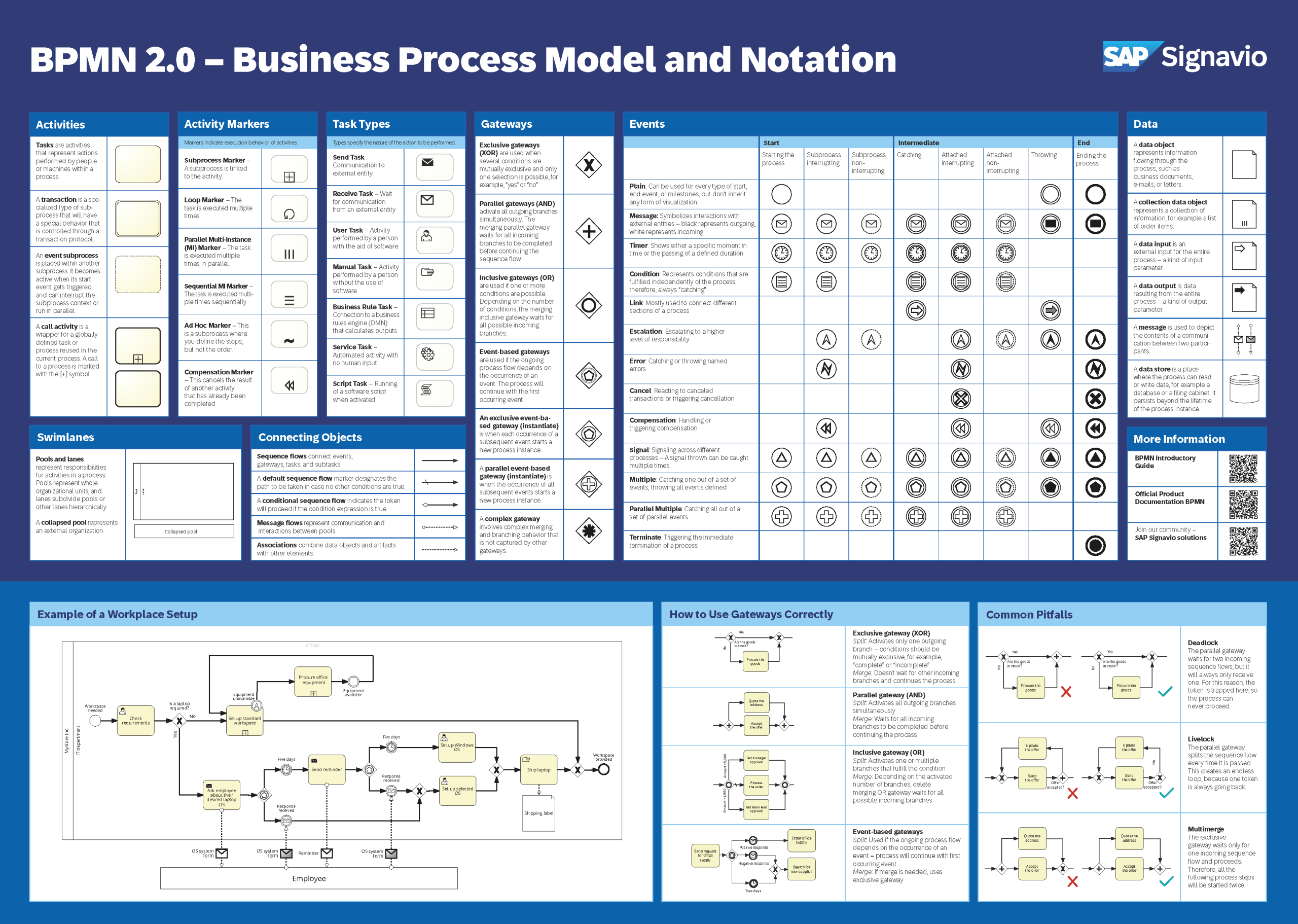
Get a BPMN 2.0 overview poster with the various graphical elements, examples of applications, and their meaning.