Benefits of Process Mapping
Process mapping benefits include better visibility, alignment, and identification of inefficiencies. It helps teams understand how work actually flows across systems and departments.



Process mapping benefits include better visibility, alignment, and identification of inefficiencies. It helps teams understand how work actually flows across systems and departments.
Process mapping is a core technique used during the process discovery stage of the BPM lifecycle. It helps organizations document how a process works by visualizing steps, roles, systems, and decisions.
The main value of process mapping comes from making work visible. Many business processes exist across teams and systems, but are not clearly documented. As a result, different teams may have different assumptions about how the same process works.
By creating a shared visual representation, process mapping helps align stakeholders and provides a structured way to analyze how work is performed. It allows teams to move from fragmented knowledge to a common understanding of the process.
This clarity becomes the foundation for identifying issues, improving workflows, and preparing processes for further analysis or automation.
Process mapping provides value by making processes visible and easier to understand across the organization. Instead of relying on assumptions or fragmented knowledge, teams can work with a shared, structured view of how work flows.
This section outlines the main benefits organizations gain when they document and analyze processes using process mapping.
In many organizations, different teams are involved in the same process but see only their part of it. This often leads to misunderstandings, duplicated work, or gaps between responsibilities.
Process mapping brings these perspectives together into one view. By documenting the full process, teams can align on how work actually flows across departments.
This helps organizations:
As a result, collaboration improves because everyone works from the same understanding.
Without a visual representation, processes are difficult to evaluate. Written descriptions or informal knowledge do not clearly show how steps connect or where issues occur.
Process maps make workflows explicit. They show the sequence of activities, decision points, and dependencies between steps.
This allows teams to:
Once the process is visible, it becomes much easier to assess and improve.
Many process issues remain hidden until they are visualized. Delays, rework, and unnecessary steps are often not obvious when looking at individual tasks.
Process mapping helps uncover these issues by showing the full flow of work. When the process is mapped, teams can see where time is lost or where work loops back.
This helps identify:
These insights provide a clear starting point for process improvement.
Processes often evolve over time, leading to different ways of performing the same task. This creates inconsistencies that affect quality and efficiency.
Process mapping helps define a standard way of working. By documenting the process, organizations can align teams around a consistent approach.
This enables:
Standardization is especially important in regulated environments or large organizations.
Business and IT teams often describe processes differently. Business teams focus on activities and outcomes, while IT focuses on systems and data.
Process maps provide a bridge between these perspectives. They connect business activities with the systems that support them.
This helps:
As a result, projects involving both business and IT become easier to manage.
Decisions about process changes are often based on assumptions or limited information. Without a clear view of the process, it is difficult to evaluate the impact of changes.
Process mapping provides a structured foundation for decision-making. It allows teams to assess where improvements are needed and what changes will have the most impact.
This supports:
Better visibility leads to more confident and accurate decisions.
Before automating or redesigning a process, organizations need to understand how it currently works. Without this understanding, automation may replicate existing inefficiencies.
Process mapping helps prepare processes for automation by clearly defining steps, rules, and dependencies.
This allows teams to:
Process mapping ensures that automation efforts are based on a well-understood process rather than assumptions.
Process mapping is one of the most widely used techniques in the process discovery stage of the BPM lifecycle. Its role is to capture how a process is understood by the people involved and to translate that knowledge into a structured, visual format.
At this stage, organizations are not yet improving or automating processes. The goal is to build a clear and shared understanding of how work currently happens. Process mapping provides a practical way to do this by organizing activities, roles, and decisions into a coherent view.
During process discovery, teams often rely on workshops, interviews, and existing documentation. Process mapping brings these inputs together and turns them into a process model that can be reviewed and discussed.
This approach is especially useful when:
By mapping the process, organizations create a baseline that reflects how the process is described by those who perform it.
Process mapping is based on human input. It reflects how employees understand and describe the process, including exceptions and context that may not be visible in systems.
Other discovery techniques focus on system data:
These methods provide a different perspective. They reveal patterns, variations, and performance issues based on real execution data.
Process mapping alone can provide strong value in certain situations, especially when:
In these cases, mapping helps establish clarity without requiring complex data analysis.
In more complex environments, relying only on process mapping can leave gaps. Teams may describe how a process should work, while actual execution may differ.
Combining mapping with data-driven techniques helps close this gap. Mapping provides structure and context, while data reveals how the process behaves in practice.
This combined approach allows organizations to:
Process mapping plays a central role in discovery because it connects people, processes, and systems into a shared understanding. It often serves as the starting point before deeper analysis or data-driven discovery is applied.
Process mapping can be applied in many situations, but its value is highest when organizations need clarity, alignment, or a structured starting point for improvement.
It is especially useful when processes are not well documented or when different teams have different views of how work is performed.
When organizations begin working with BPM, they often lack a clear view of their processes. Knowledge is scattered across teams, and there is no consistent documentation.
Process mapping provides a practical starting point. It allows teams to quickly document key processes and build an initial understanding of how work flows across the organization.
This helps establish a foundation for further activities such as analysis, optimization, and automation.
Many business processes evolve over time without formal design. Employees develop their own ways of completing tasks, which can lead to inconsistencies and hidden dependencies.
Process mapping helps capture this informal knowledge and turn it into a structured process model.
This is particularly valuable when:
Processes that span multiple teams or departments are often difficult to understand end-to-end. Each team focuses on its own tasks, but the overall flow is not clearly visible.
Process mapping brings these parts together into a single view. It shows how work moves between teams and where handoffs occur.
This helps organizations:
New employees often struggle to understand how processes work, especially in complex environments. Documentation is either missing or difficult to follow.
Process maps provide a clear and visual way to explain workflows. They help new team members understand not only what they need to do, but also how their work fits into the larger process.
This supports:
Before analyzing or automating a process, organizations need a clear understanding of how it works today.
Process mapping helps define the structure of the process, including steps, roles, and dependencies. This creates a baseline that can be used for further analysis or technical implementation.
It allows teams to:
Process mapping delivers the most value when it creates clarity in situations where processes are unclear, fragmented, or undocumented. It helps organizations move from uncertainty to a structured understanding of how work is performed.
Process mapping is a useful technique for understanding how work is performed. However, it has limitations that organizations need to be aware of, especially when processes become complex or highly variable.
These limitations do not reduce its value, but they highlight why mapping is often combined with other discovery methods.
Process mapping is typically based on workshops, interviews, and documentation. This means the quality of the map depends on the knowledge and perspective of the participants.
In practice, employees may describe how the process should work rather than how it actually works. Some steps may be forgotten, simplified, or interpreted differently across teams.
This can lead to:
Because process mapping relies on human input, it often captures the “ideal” version of a process.
In reality, processes can vary depending on context, system behavior, or individual decisions. These variations are not always visible during workshops.
As a result, process maps may:
In many organizations, a single process can have many variants. These differences may depend on customer type, region, system configuration, or specific conditions.
Process mapping typically produces one or a few simplified representations of the process. It does not easily capture the full range of variations across large volumes of cases.
This makes it harder to:
Process maps show structure, but they do not provide data on how the process performs over time.
Without additional data, it is difficult to answer questions such as:
To address these limitations, organizations often combine process mapping with data-driven discovery methods.
Techniques such as process mining and automated process discovery provide insights based on system data and execution patterns. They help validate and extend the process map with objective evidence.
By combining approaches, organizations can:
Process mapping remains a foundational technique in process discovery. Its limitations highlight the importance of using multiple perspectives—both human and data-driven—to fully understand how processes operate.
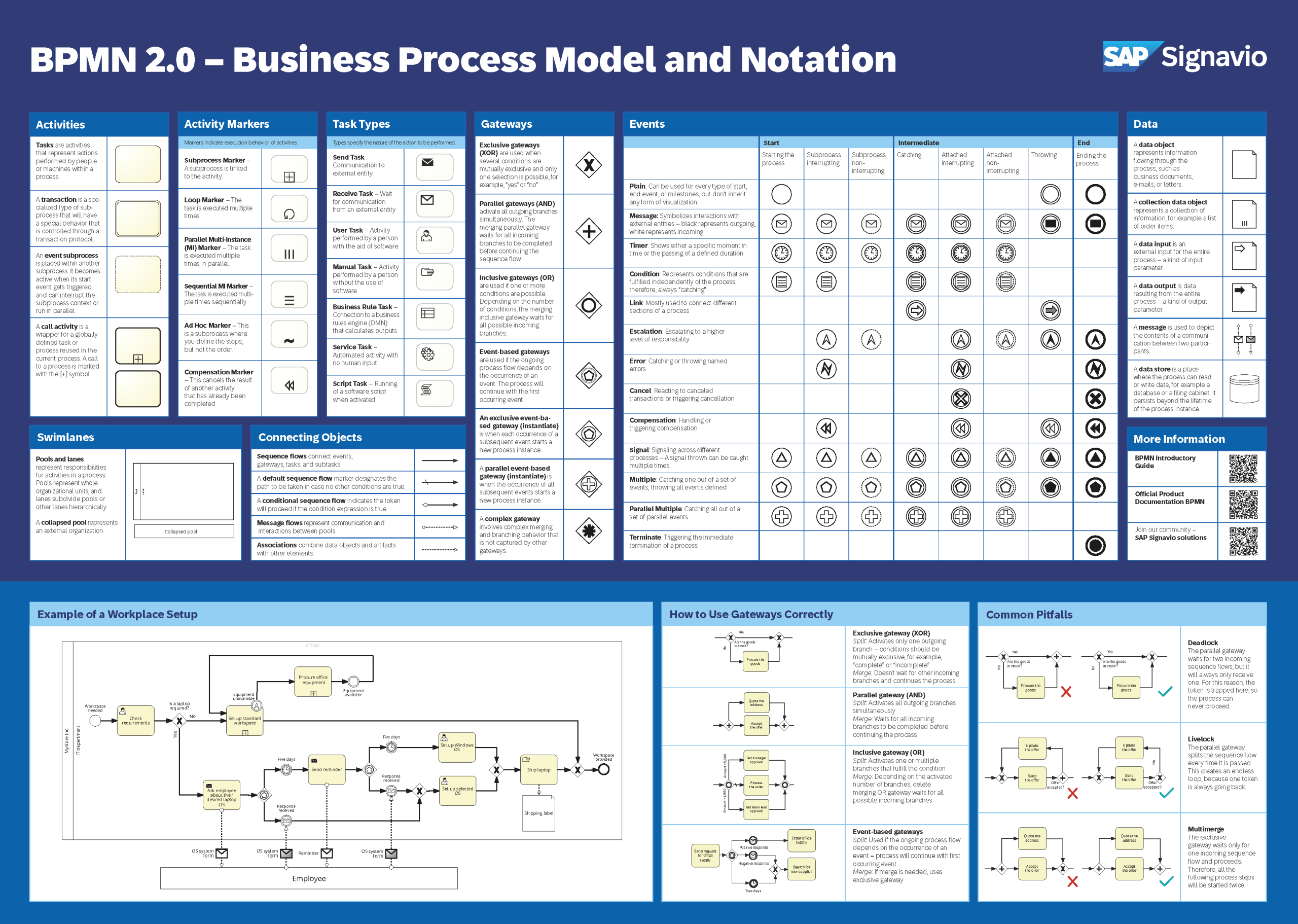
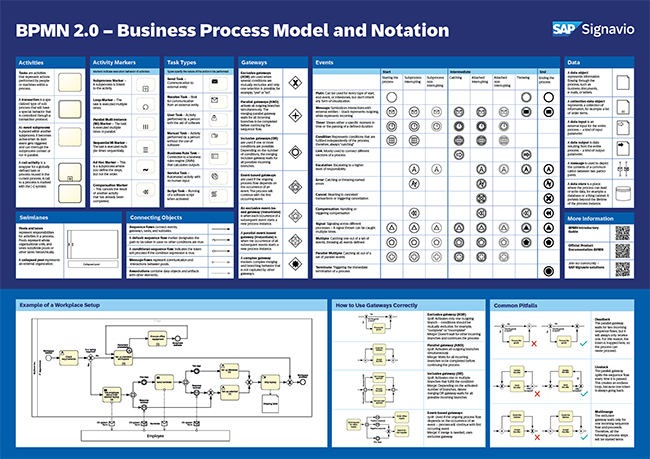
Get a BPMN 2.0 overview poster with the various graphical elements, examples of applications, and their meaning.