Types of Digital Twins
The main types of digital twins are component, asset, process, system, and organizational twins, each representing a different scope from part to enterprise.



The main types of digital twins are component, asset, process, system, and organizational twins, each representing a different scope from part to enterprise.
Digital twin types are defined by the scope of what they represent, from a single physical component to an entire organization's processes and capabilities. The five main types follow a hierarchy of scale.
| Type | Scope | Primary use case |
|---|---|---|
| Component twin | A single part or component within an asset | Engineering validation, failure prediction for individual components |
| Asset twin | A complete physical asset (a machine, a vehicle, a facility) | Operational monitoring, predictive maintenance |
| Process twin | A business or operational process | Process performance monitoring, conformance checking, simulation |
| System twin | Multiple connected assets or processes working together | System-level optimization, interdependency analysis |
| Organizational twin (DTO) | An entire organization: its processes, capabilities, systems, and data | Enterprise transformation, process governance, strategic change management |
A component twin is a digital model of a single physical part (a sensor, a motor, a component within a larger product) that mirrors the component's real-time operational state. Component twins originated in manufacturing and aerospace engineering, where they support failure prediction and design validation. In a process context, the component twin concept is less directly applicable; its closest analogue is the individual activity or decision point within a process model.
An asset twin is a digital model of a complete physical asset that integrates data from all its constituent components into a single operational picture. Asset twins support predictive maintenance and performance optimization for physical equipment. In process management, the asset twin concept maps to the level of a single enterprise system (SAP S/4HANA as an asset within the broader process landscape) rather than to a business process itself.
A process twin is a data-driven digital model of a business process. It is built from event log data extracted from the enterprise systems that execute the process and is used to monitor real process performance, detect conformance failures, and simulate the impact of process changes before deployment. The process twin is the type most directly relevant to process excellence teams, COE leads, and process analysts working in business process management and process transformation contexts.
The process twin is built through process mining: event logs from SAP S/4HANA, SAP Ariba, Salesforce, ServiceNow, and other enterprise systems provide the execution data; process mining algorithms reconstruct the actual process model from that data; BPMN models provide the structural reference for conformance checking; simulation applies proposed changes to the calibrated model to project outcomes.
A system twin is a digital model of multiple connected processes or systems operating together. It captures how those processes interact and depend on each other at a scale above the individual process. In process management, system twins are relevant for cross-functional process architectures: the Order-to-Cash process as a system of connected sub-processes spanning sales, fulfilment, invoicing, and collections, modelled as a single interconnected system rather than as isolated workflows.
An organizational twin, also called a digital twin of an organization (DTO), is a digital model of an entire organization's processes, business capabilities, systems, and data flows. It enables leaders to simulate transformation scenarios and make governance decisions before live operations are changed. The DTO is built on a foundation of process twins and system twins, aggregated to the organizational level.
For a Head of Process Excellence, the DTO is the type that provides enterprise-wide process visibility. It connects performance data from individual processes into an organizational picture that supports COE portfolio decisions, transformation program planning, and governance reporting.
Digital twins and simulations are both modelling tools, but they operate on different data foundations.
A simulation is a model that runs on assumed or estimated inputs. It does not require a live connection to the system it models; it runs on parameters the model designer specifies for expected behavior under defined conditions. Simulations are useful for general-purpose scenario analysis when real operational data is not available.
A digital twin is a model that runs on real operational data from the system it represents, continuously updated as the system changes. The twin reflects actual behavior; simulation within the twin tests proposed changes on that real data baseline.
| Dimension | Simulation | Digital twin |
|---|---|---|
| Data source | Assumed or estimated parameters | Live event log data from executing systems |
| Currency | Static: reflects parameters at model creation | Dynamic: updated as execution data arrives |
| Purpose | General-purpose scenario analysis | Monitor real performance; test changes on real data |
| Accuracy dependency | Accuracy of input assumptions | Completeness and accuracy of event log data |
| Use in process decisions | Useful when no historical execution data exists | Useful for decisions about a specific, live process |
Digital twins use simulation as a capability, running "what if" scenarios on real process data to project the impact of proposed changes. The distinction is that the process digital twin's simulation operates on evidence from real execution, not on assumptions about how a process might behave.
A related distinction that comes up in vendor conversations, though less relevant for process practitioners, is the difference between "digital twin" and "virtual twin."
The term "virtual twin" is used primarily by Dassault Systèmes to describe a digital twin that incorporates 3D visualization and virtual reality interfaces. A virtual twin provides the same data-connectivity and modelling capabilities as a digital twin, with the addition of immersive visualization that allows users to explore the model in a 3D environment.
For process management purposes, the distinction is not operationally significant. "Digital twin" is the standard term used by industry bodies including the Digital Twin Consortium, Gartner, and ISO. Process twins (built on event log data, BPMN 2.0 models, and simulation) do not require 3D visualization to deliver their value. The "virtual twin" term is relevant primarily in manufacturing, product design, and engineering contexts where spatial visualization of physical systems is a core use case.
For process excellence teams, COE leads, and process analysts, the process twin is the primary working type. It operates at the level of the processes these functions are accountable for (Order-to-Cash, Procure-to-Pay, HR onboarding, finance close) and delivers the performance monitoring, conformance checking, and simulation capabilities that process transformation programs require.
The organizational twin (DTO) is the next level up, relevant when process excellence teams need an enterprise-wide view of process performance, or when transformation programs require understanding how process changes interact with organizational structure, system landscape, and business capabilities. The DTO aggregates process twin data to the enterprise level.
This decision framework maps BPM use cases to twin types:
| If your goal is... | The relevant twin type is... |
|---|---|
| Monitor a single end-to-end process (e.g. O2C, P2P) | Process twin |
| Detect conformance failures in a compliance-sensitive process | Process twin |
| Simulate the impact of a process redesign before deployment | Process twin with simulation layer |
| Understand how multiple processes connect and interact | System twin |
| Support enterprise-wide transformation governance | Organizational twin (DTO) |
The process twin's role becomes clearest in BPM lifecycle and process transformation practice, where most process excellence teams first encounter it.
The process twin is native to BPM and process transformation practice: it is built from event log data organizations already generate, uses BPMN 2.0 as the modelling language process teams already work in, and feeds into the same decisions that process excellence functions are accountable for.
In BPM practice, the process twin closes the gap between the designed process (documented in BPMN 2.0) and the operational process (recorded in event logs). Conformance checking measures that gap continuously. When a process drifts from its designed path (due to workarounds, system changes, or organizational shifts), the twin surfaces the deviation before it becomes entrenched.
In process transformation, the process twin provides two capabilities that point-in-time process mining projects do not: the operational baseline for measuring transformation impact, and the simulation layer for testing proposed changes before deployment. Transformation teams that use a process twin can measure whether their changes achieved the intended effect, comparing post-change execution against the pre-change baseline and the simulation projection.
In compliance-sensitive processes, the process twin's conformance monitoring replaces periodic audit sampling with continuous deviation detection. For processes that must follow defined approval sequences (Procure-to-Pay, financial controls, HR processes), conformance scores provide a real-time compliance signal that audit-based review cannot match.
SAP Signavio Process Intelligence provides the platform for building and operating process twins. It combines process mining, BPMN modelling, conformance checking, and simulation in a single integrated product that supports all three BPM use cases described above.
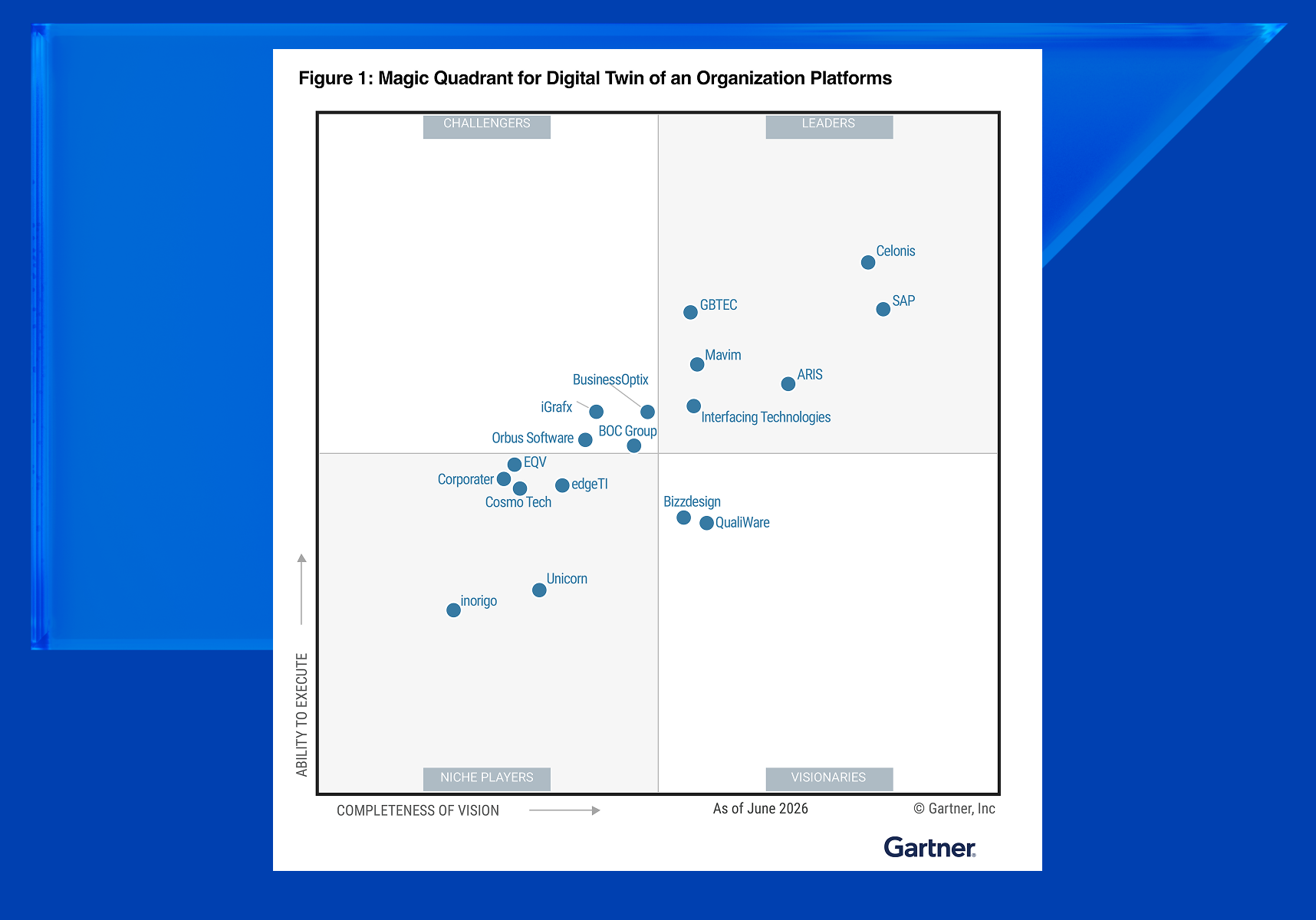
Download your complimentary copy of the report and see how SAP solutions were evaluated in this category.

Yes. A process twin for a cross-system process like Order-to-Cash integrates event log data from all systems involved: SAP S/4HANA for order management, a separate CRM for customer interaction, a logistics system for fulfilment. The twin constructs a unified end-to-end process model from the combined event data, with full process visibility regardless of system boundaries.

Gartner, Inc. Magic Quadrant for Digital Twin of an Organization Platforms. Marc Kerremans, David Sugden, etl. 27 July 2026.
Gartner and Magic Quadrant are trademarks of Gartner, Inc. and/or its affiliates.
Gartner does not endorse any company, vendor, product or service depicted in its publications, and does not advise technology users to select only those vendors with the highest ratings or other designation. Gartner publications consist of the opinions of Gartner's business and technology insights organization and should not be construed as statements of fact. Gartner disclaims all warranties, expressed or implied, with respect to this publication, including any warranties of merchantability or fitness for a particular purpose.