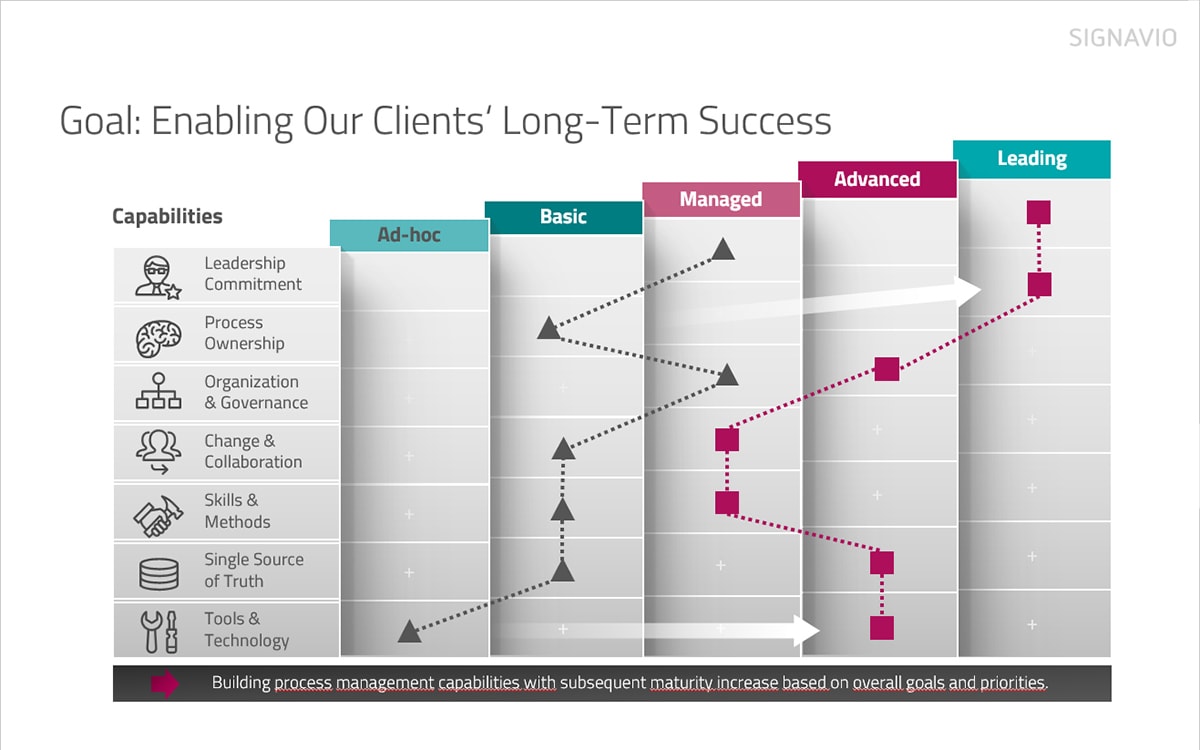
Key dimensions used in BPM maturity assessment
Understanding BPM maturity dimensions is essential because they form the foundation for evaluating how well an organization manages, governs, and improves its processes. Each dimension represents a core capability area that influences the organization’s ability to scale BPM practices and execute its BPM strategy effectively.
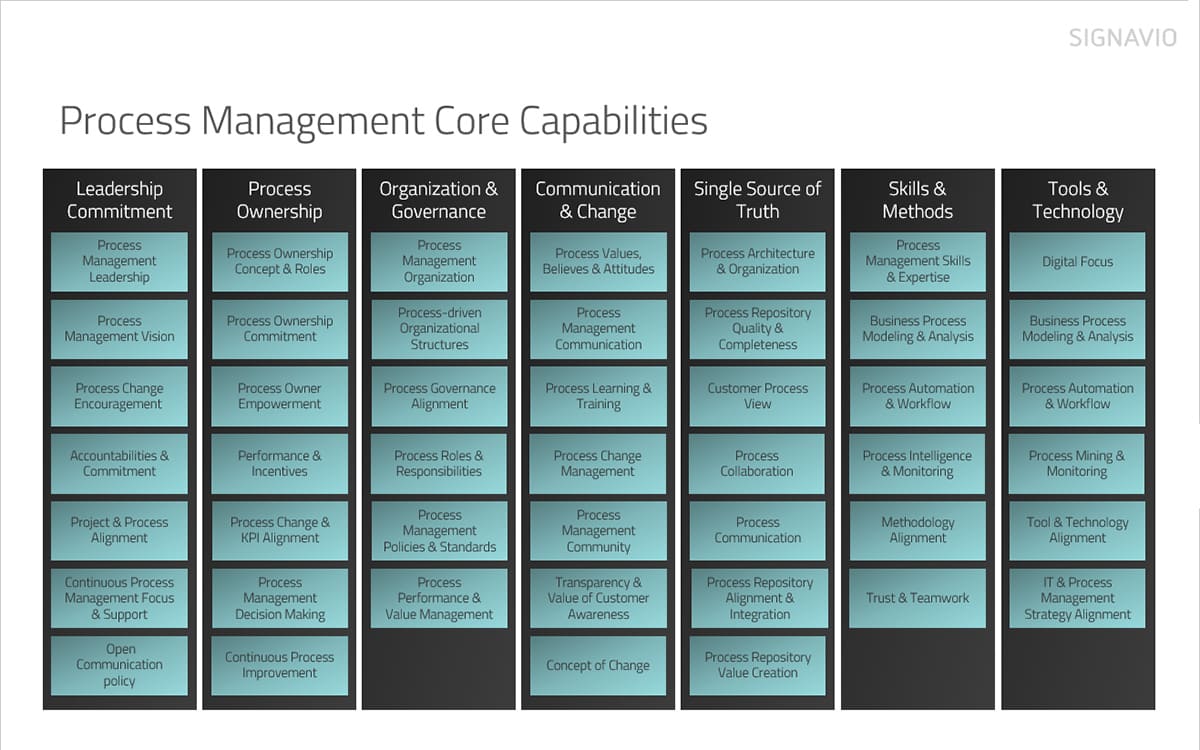
Below is a deep dive into the key dimensions used in BPM maturity assessments.
Governance & ownership
Governance defines how process responsibilities are assigned, how decisions are made, and how changes are controlled. It is one of the strongest predictors of BPM maturity.
Without clear ownership and governance, even well-designed processes fail to stay up to date or aligned with business needs. Mature governance ensures that process management is not optional—it becomes part of how the organization operates.
What elements does it include?
- Process ownership: Who is accountable for each process end-to-end.
- Decision rights: How changes are approved and by whom.
- Review cycles: How often processes are revisited and updated.
- Policies and standards: Rules governing modeling, documentation, and versioning.
- Alignment with strategy: How decisions tie back to organizational priorities.
Process design & documentation quality
This dimension evaluates how well processes are captured, structured, and maintained. High-quality documentation enables transparency, onboarding, consistency, and collaboration across teams.
As maturity grows, organizations move from ad-hoc diagrams to standardized process models with clear relationships, inputs, outputs, and supporting systems.
What elements does it include?
- Modeling standards: Use of BPMN or other conventions.
- Completeness: Level of detail in process descriptions.
- Consistency: Similar structure across departments or teams.
- Process hierarchy: Clear linkage from value chains to activities.
- Change control: How updates are validated and republished.
Collaboration & culture
BPM succeeds only when teams actively participate in designing and improving processes. This dimension evaluates how embedded BPM is in daily work and whether teams see process management as part of their responsibilities.
Culture becomes especially important when BPM expands across functions, requiring shared standards and joint decision-making.
What elements does it include?
- Cross-functional collaboration: How teams align on shared workflows.
- Engagement: Willingness of teams to contribute to process improvement.
- Adoption of standards: Consistency in following process rules.
- Communication: How process updates are shared across the organization.
- Mindset: Whether BPM is seen as “documentation work” or a value driver.
Data, KPIs & measurement
Measurement is central to BPM maturity. This dimension assesses how well the organization defines, captures, and uses process performance data.
Mature BPM practices rely on KPIs, dashboards, and mining insights to support improvement decisions and validate the impact of changes.
What elements does it include?
- KPI definition: Clear process indicators (e.g., cycle time, error rate).
- Data quality: Accuracy and completeness of execution data.
- Analysis routines: How often performance is reviewed.
- Mining insights: Use of process mining to identify real behavior.
- Decision-making: How data informs prioritization and improvement.
Technology, automation & integration
Technology enables BPM to scale beyond manual documentation. This dimension evaluates the tooling landscape supporting modeling, workflows, integrations, mining, and AI-assisted analysis.
As maturity increases, organizations shift from fragmented tools to more integrated BPM platforms that support end-to-end lifecycle management.
What elements does it include?
- Modeling repositories: Centralized documentation systems.
- Workflow automation: Ability to standardize execution.
- Integration capabilities: Connections to ERP, CRM, and other systems.
- Process mining: Data-driven visibility into execution patterns.
- AI capabilities: Automated modeling, insights, or recommendations.
Continuous improvement capabilities
Continuous improvement determines whether BPM becomes a sustained practice rather than a project. This dimension evaluates how consistently processes are reviewed, improved, and aligned with changing business requirements.
High maturity means improvement is systematic, supported by data, and embedded in team routines.
What elements does it include?
- Improvement cycles: Predictable cadence for updating processes.
- Prioritization: How improvement opportunities are selected.
- Change management: Structured approach for implementing changes.
- Impact measurement: Ability to validate improvements.
- Alignment: How improvements support strategic goals.