Digital Twin Benefits
Benefits of a digital twin include continuous process visibility, faster improvement cycles, reduced transformation risk, and compliance readiness.



Benefits of a digital twin include continuous process visibility, faster improvement cycles, reduced transformation risk, and compliance readiness.
The organizational digital twin changes how process excellence teams and COE leads work by replacing static process maps and periodic audit-based assessments with a continuously updated model of how processes actually execute. The benefits are most visible in five areas: process visibility, improvement speed, transformation risk, compliance, and decision quality.
The core benefit of a process digital twin is seeing how processes execute in reality, not how they were designed to run or how they were running when the last assessment was completed. Traditional process management relies on documentation that reflects design intent, supplemented by periodic mining projects or workshop-based reviews. Between reviews, process execution drifts. Workarounds accumulate, exception paths normalize, and by the time the next review arrives, the documented process no longer matches what runs in production.
The digital twin eliminates this lag. Event log data from SAP S/4HANA, SAP Ariba, and connected enterprise systems feeds the process mining model continuously, so the COE has a current picture of process performance across every business unit and transaction type. When the Order-to-Cash process develops a new exception pattern in one region, the twin surfaces it immediately, not at the next quarterly review.
Process improvement programs that rely on workshop-based discovery, manual data collection, and consultant-led analysis typically take months to complete. Data preparation alone can consume weeks of a mining project: extracting and cleansing event logs from enterprise systems is usually the most time-intensive phase. With a process digital twin already operational, that infrastructure is in place. The event data is already extracted and structured, so improvement analysis begins immediately rather than waiting on data collection.
For a Head of Process Excellence running multiple improvement workstreams in parallel, this means faster time from identification to action. Root cause analysis that previously required two to three weeks of data preparation can be completed in hours, with the event log already connected and the process model already built. In one example, an aerospace company achieved a 20% improvement in cash flow process cycle time using a DTO. The result depended on continuous visibility into process execution rather than periodic analysis.
Business transformation programs (system migrations, organizational restructuring, regulatory compliance rollouts) frequently encounter unexpected process disruptions because the transformation plan was based on how processes were designed to run, not how they actually run. Undocumented variants and cross-system dependencies that do not appear in process documentation generate rework and delays when the transformation encounters them in production.
The process digital twin reduces this risk in two ways. First, process discovery exposes the full variant distribution before the transformation begins: the program plan then accounts for how processes actually execute, including exception paths that documentation does not capture. Second, simulation lets teams project the impact on cycle time, exception volume, and resource load against real process data before deployment, so nothing goes live untested.
Compliance depends on processes executing in defined sequences with defined approvals, consistently. The gap between the compliant path and the actual execution path is where compliance risk accumulates, and in most organizations that gap is not visible until an audit surfaces it.
Conformance checking within the process digital twin continuously compares actual execution against the defined compliant path. Deviations (skipped approvals, resequenced activities, exception paths that bypass required controls) surface as they occur and go to the process owner for investigation. For a COE running compliance processes in finance or procurement, this continuous conformance monitoring shifts audit preparation from reactive evidence gathering to ongoing process assurance.
Process improvement decisions made without execution data are opinion-based. Workshop participants describe how they believe the process works; consultants document what they observe in a limited time window; management makes investment decisions based on summaries that may not reflect current operational reality. The process digital twin provides the execution data to make process decisions evidence-based.
A process analyst can identify which paths drive cycle time variance through variant analysis; a Head of Process Excellence can rank improvement workstreams by quantified KPI impact. A CFO evaluating a finance transformation investment can see the current baseline and the projected outcome of any proposed change, both drawn from real execution data.
Traditional process management practice relies on BPMN models and standard operating procedures that are created once and updated manually when processes change. The organizational digital twin does not replace process documentation: it connects that documentation to operational reality.
| Dimension | Traditional process documentation | Process digital twin |
|---|---|---|
| Model currency | Updated manually when processes change: typically lags operational reality | Continuously updated from event log data: reflects current execution |
| Data source | Workshop outputs, interviews, manual observation | Event logs extracted from SAP and non-SAP enterprise systems |
| Conformance monitoring | Periodic audits and manual sampling | Continuous: deviations detected as they occur |
| Improvement basis | Expert judgment and workshop findings | Variant analysis, root cause drill-down, performance KPIs from real execution data |
| Change testing | Not possible before deployment | Simulation models projected impact before any change is made live |
| Coverage | Designed process paths | All executed paths: including variants, exceptions, and workarounds |
The shift from traditional process documentation to the process digital twin is most significant in two areas: the frequency with which the model reflects reality, and the ability to test changes before they are made. Both directly affect the quality of process improvement decisions.
Seeing both the benefits and the constraints gives teams a clearer basis for deciding where the investment is justified and how to scope it.
Understanding both sides of the value equation helps process excellence leaders scope the investment realistically. The advantages are most pronounced where traditional process management creates recurring friction; the constraints are concentrated in the early data infrastructure phase.
The advantages come through most clearly in programs where traditional process management creates the most friction: where data is stale, governance is inconsistent, or outcomes are hard to measure.
The process digital twin also carries implementation constraints that determine how much effort is required before the benefits materialize.
With both benefits and implementation requirements in view, teams can more readily identify which organizational challenges actually justify building a digital twin.
The process digital twin directly addresses four challenges that limit the effectiveness of traditional process management:
Process opacity: most organizations have no clear view of how their key processes actually execute across business units; the digital twin builds that picture from system data rather than documentation or observation
Slow improvement cycles: process improvement programs that rely on periodic data collection and manual analysis run too slowly to keep pace with the business; the digital twin provides the persistent analytical infrastructure that allows improvement to run continuously
Invisible compliance risk: process deviations that bypass required controls accumulate between audit cycles; conformance monitoring within the twin surfaces these deviations in real time, before they reach the audit
High-stakes transformation decisions without evidence: restructuring a high-volume process without understanding how it currently runs in all its variants creates avoidable risk; the digital twin provides the execution baseline and the simulation capability to make transformation decisions on evidence
The challenges themselves are easy to name; what takes more work is navigating the implementation realities.
The most common implementation challenges are:
Taken together, this changes how transformation works. The process model runs continuously, generating the data that simulation testing and post-change measurement both depend on. The work becomes a persistent capability rather than a calendar-driven program. Organizations that operate this way treat transformation as an ongoing function.
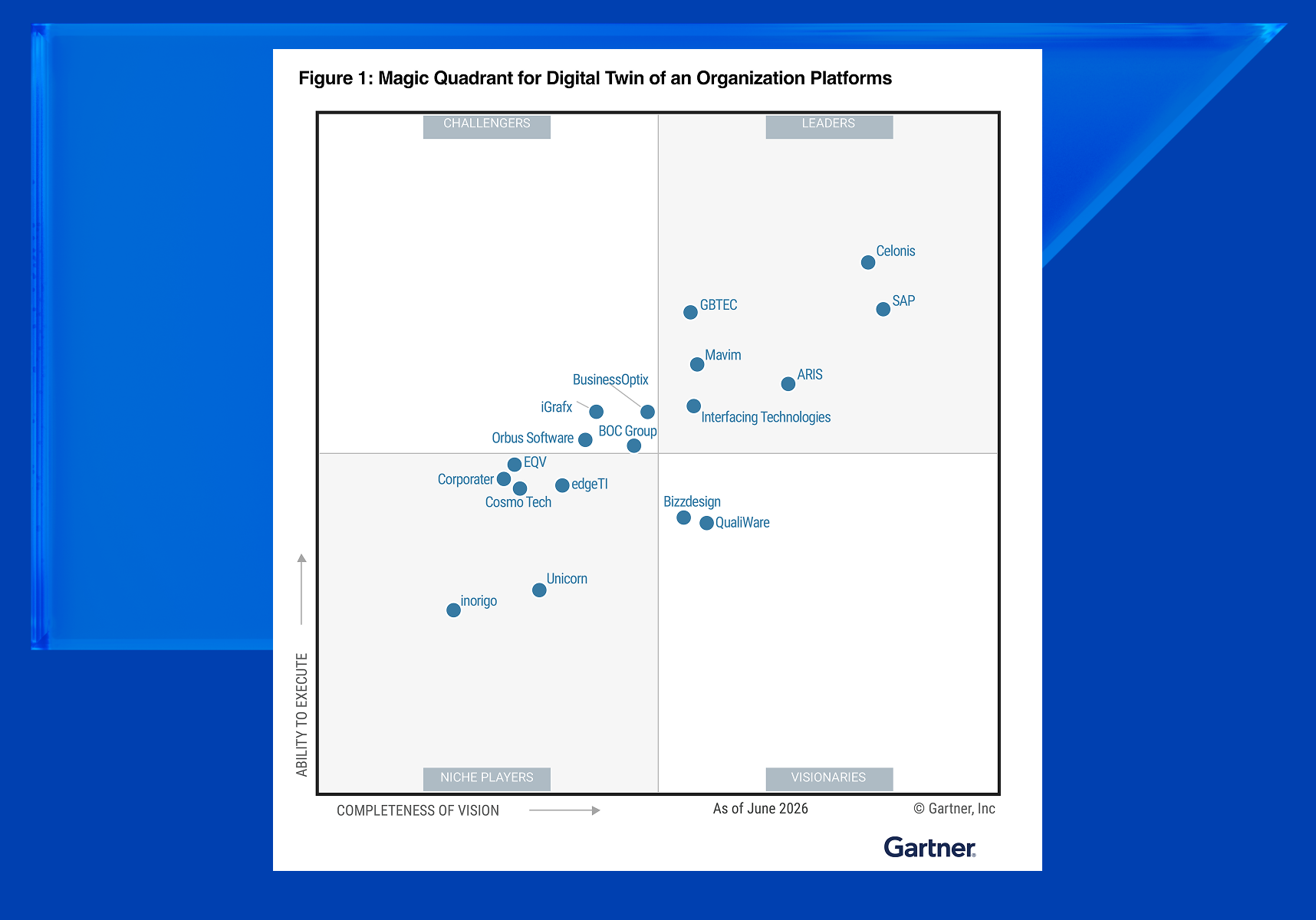
Download your complimentary copy of the report and see how SAP solutions were evaluated in this category.

The process digital twin delivers the most immediate value in high-volume, cross-system transactional processes (Order-to-Cash, Procure-to-Pay, finance close) where execution data is abundant and performance KPIs are clearly defined. For lower-volume or more variable processes, the twin still provides conformance monitoring and improvement visibility, but variant analysis needs enough transaction volume to produce meaningful results. Most COEs start with their highest-volume processes.

Gartner, Inc. Magic Quadrant for Digital Twin of an Organization Platforms. Marc Kerremans, David Sugden, etl. 27 July 2026.
Gartner and Magic Quadrant are trademarks of Gartner, Inc. and/or its affiliates.
Gartner does not endorse any company, vendor, product or service depicted in its publications, and does not advise technology users to select only those vendors with the highest ratings or other designation. Gartner publications consist of the opinions of Gartner's business and technology insights organization and should not be construed as statements of fact. Gartner disclaims all warranties, expressed or implied, with respect to this publication, including any warranties of merchantability or fitness for a particular purpose.