Digital Twin for Process Mining
A digital twin for process mining is a live model built from event log data to monitor execution, detect conformance failures, and test process changes.



A digital twin for process mining is a live model built from event log data to monitor execution, detect conformance failures, and test process changes.
Most organizations know how their processes are supposed to work. Few have a live view of how they actually run. A digital twin built from process mining data bridges that gap, turning transactional event logs into a continuously updated operational model that surfaces performance, compliance, and deviation in real time.
A digital twin for process mining is the operational layer of the organizational digital twin, built not from documentation or workshops but directly from the event data that enterprise systems generate when executing business processes. Every transaction, approval, handoff, and exception leaves a trace in the source system. Process mining extracts those traces, structures them into process models, and produces a digital twin that reflects how the process actually runs.
The term "digital twin" in this context refers to a synchronized copy of the live process: a model that is continuously updated as new events occur, so that the twin stays current with operational reality. When a Purchase Order is created in SAP S/4HANA, that event updates the Procure-to-Pay twin. When an invoice is paid late, the deviation is captured in the model immediately, not in the next quarterly audit.
Process mining creates the digital twin by converting event log data into a structured process model through three operations: discovery, conformance checking, and monitoring.
Discovery reconstructs the actual process from event data, identifying every path a case has taken through the process, the frequency of each path, and the cycle time distribution across variants. The result is a process model derived from evidence, not from memory or documentation.
Conformance checking compares the discovered model against the designed process, the BPMN model that represents how the process should run. Deviations are scored and classified: which activities were skipped, which were executed out of sequence, and which cases followed the compliant path versus an exception path.
Monitoring keeps the twin synchronized with live execution. As new events arrive from source systems, the model updates, surfacing performance KPIs, conformance scores, and deviation alerts in near real time.
The event log is the raw input that makes the process mining digital twin possible. An event log is a structured record of every step taken in a business process, containing at minimum three fields: a case identifier (the process instance, an order number, a patient ID, a claim reference), an activity name (the step performed), and a timestamp (when the step occurred). Optionally, the event log includes the resource, the person, system, or role that performed the activity. The event log structure and how it is extracted is covered in depth on the process mining wiki.
For SAP environments, event logs are extracted directly from SAP application tables. SAP S/4HANA, SAP Ariba, SAP SuccessFactors, and other SAP applications record transactional events in a format that can be mapped to the required event log structure without custom development. For non-SAP environments, connectors extract and transform source data into the same structure.
The quality of the digital twin depends on the completeness and accuracy of the event log. Missing timestamps, inconsistent case identifiers, or incomplete activity coverage produce gaps in the model, areas where the twin does not reflect reality because the data does not capture it.
Building a process mining digital twin follows four phases. Each phase produces outputs that feed into the next, and the cycle continues as long as the process runs.
Process discovery applies process mining algorithms to the event log to reconstruct actual process execution as a process model. The output is not a flowchart created in a workshop. It is a model derived algorithmically from thousands or millions of process traces.
The discovered model shows the full variant distribution: the most common path the process follows, the frequency of each variant, and the percentage of cases that deviate from the expected flow. For an Order-to-Cash process, discovery typically reveals that a majority of orders follow the standard path, while a significant share route through exception paths, manual credit holds, invoice corrections, approval bypasses, each with its own cycle time profile. Each variant is visible in the model with its associated cycle time and volume.
Conformance checking measures the distance between how the process was designed to run and how it actually runs. The designed process, documented as a BPMN model, provides the reference. The discovered model provides the evidence. Conformance checking computes a score for each case and for the process overall, identifying the specific deviations that account for the gap.
Conformance scores are actionable signals for process analysts. A low conformance score in the invoice approval step of a Procure-to-Pay process indicates that approvals are being skipped or resequenced. That has direct consequences for both throughput and regulatory compliance. Conformance checking surfaces these findings automatically, without requiring manual sampling or audit-based review.
Process monitoring connects the digital twin to live execution data on a continuous basis. New event data from source systems updates the process model in near real time, keeping performance KPIs, variant distributions, and conformance scores current.
Monitoring rules define the conditions under which the twin triggers an alert. A cycle time threshold breach, an Order-to-Cash case exceeding 30 days without reaching the invoicing step, generates a notification for the process owner. A conformance drop below a defined threshold in a compliance-sensitive process generates a signal for the COE. These alerts arrive in time to investigate and correct the deviation, rather than discovering it after the fact.
Simulation is the forward-looking layer of the process mining digital twin. With a calibrated process model and real performance data as input, simulation allows analysts to modify process parameters and observe the projected impact before any change is made in the live system.
A process analyst redesigning the invoice matching step in a Procure-to-Pay process can run a simulation that tests the proposed change against current throughput volumes and resource capacity. The simulation returns projected cycle time, exception rate, and resource utilization, answering the question "what will happen if we make this change" with quantitative evidence rather than estimation.
Traditional process mining and the process mining digital twin use the same underlying data and algorithms. The distinction is in continuity and integration.
| Dimension | Traditional process mining | Process mining digital twin |
|---|---|---|
| Model currency | Point-in-time snapshot: reflects execution up to the analysis date | Continuously updated: reflects current execution in near real time |
| Conformance monitoring | Checked manually, per project cycle | Automated, continuous: alerts fire on deviation |
| Simulation | Separate capability, often in a different tool | Integrated: simulation runs on the same model that monitoring uses |
| Scope | Single process, single time period, single analysis project | Ongoing operational model: multiple processes, live data, persistent |
| Output | Findings report and recommendation deck | Operational dashboard, alert system, and scenario-testing environment |
| Use in transformation | Evidence for a transformation business case | Decision-support tool throughout the transformation lifecycle |
The process mining digital twin is not a replacement for project-based process mining analysis. Initial discovery and deep-dive root cause investigations still follow a project-based model. The twin is the operational infrastructure that surrounds those projects, keeping the process visible between analyses and measuring whether improvement actions are working.
The process mining digital twin creates operational value at three levels: visibility, speed, and risk reduction.
Process analysts and COE leads typically work with process data that is weeks or months old by the time it reaches them. Point-in-time analyses reflect the process as it was when the data was extracted, not as it is running today. The process mining digital twin eliminates this lag. Performance KPIs, variant distributions, conformance scores, and exception rates update as execution data arrives, giving process teams a current picture of operational performance without waiting for the next analysis cycle.
Continuous visibility changes the nature of process management. Instead of discovering that a process has been running off-track for three months, the process owner receives an alert when the deviation starts, with time to investigate the root cause and correct it before the impact compounds.
When a process KPI deteriorates, cycle time increases, exception volume spikes, or conformance drops, the process mining digital twin provides the data needed to diagnose the root cause directly. Variant analysis isolates which paths are driving the performance change. Conformance checking identifies which activities are deviating from the expected sequence. Attribute analysis correlates the performance change with specific case attributes, order type, customer segment, business unit, to narrow the investigation.
This analysis that previously took days of data preparation and manual filtering can be completed in hours, because the event data is already structured, the model is already built, and the twin surfaces the relevant dimensions automatically.
Process transformation programs carry operational risk: a change that improves throughput in one part of the process can create bottlenecks or increase exception rates downstream. Simulation within the process mining digital twin quantifies that risk before the change is deployed. Teams can test multiple scenarios, compare projected outcomes, and choose the approach with the best risk-adjusted performance profile, with confidence built on real process data rather than assumptions.
The process digital twin has broad applicability wherever business processes generate event log data and where the cost of process deviation, in cycle time, compliance, or cost, is measurable.
Finance processes are among the most process-mining-amenable in any organization. Order-to-Cash and Procure-to-Pay are high-volume, cross-system processes with clear performance KPIs, days sales outstanding, invoice cycle time, payment on time, and significant compliance requirements around approval sequences and audit trails.
A process digital twin built on SAP S/4HANA Finance event data gives the finance COE continuous visibility into how these processes execute across every business unit, legal entity, and customer segment. Conformance monitoring detects approval bypasses in real time. Simulation tests the impact of proposed payment term changes or invoice automation before rollout.
Healthcare organizations run complex, multi-system processes where delays have direct patient impact and compliance failures carry regulatory consequences. Patient flow processes, admission, treatment, discharge, involve dozens of handoffs across clinical and administrative systems. Billing processes must conform to payer-specific rules and regulatory requirements.
A process digital twin built on hospital information system event data gives operations teams visibility into patient flow bottlenecks: where cases queue, which steps are frequently resequenced, and where the process diverges from the clinical pathway. For billing, conformance checking detects claim preparation deviations before submission, reducing denial rates and rework.
Manufacturing processes generate event data from ERP systems, MES platforms, and IoT-connected equipment. A process digital twin integrating data from SAP S/4HANA Manufacturing and connected production systems gives operations leaders a live view of production cycle execution, identifying where planned sequences deviate, where unplanned downtime creates cascading delays, and where supply chain variability propagates into production.
Simulation within the manufacturing DTO tests production schedule changes, capacity reallocation decisions, and supplier substitution scenarios before they are committed. That limits disruption risk when changes touch complex production networks where failures propagate quickly.
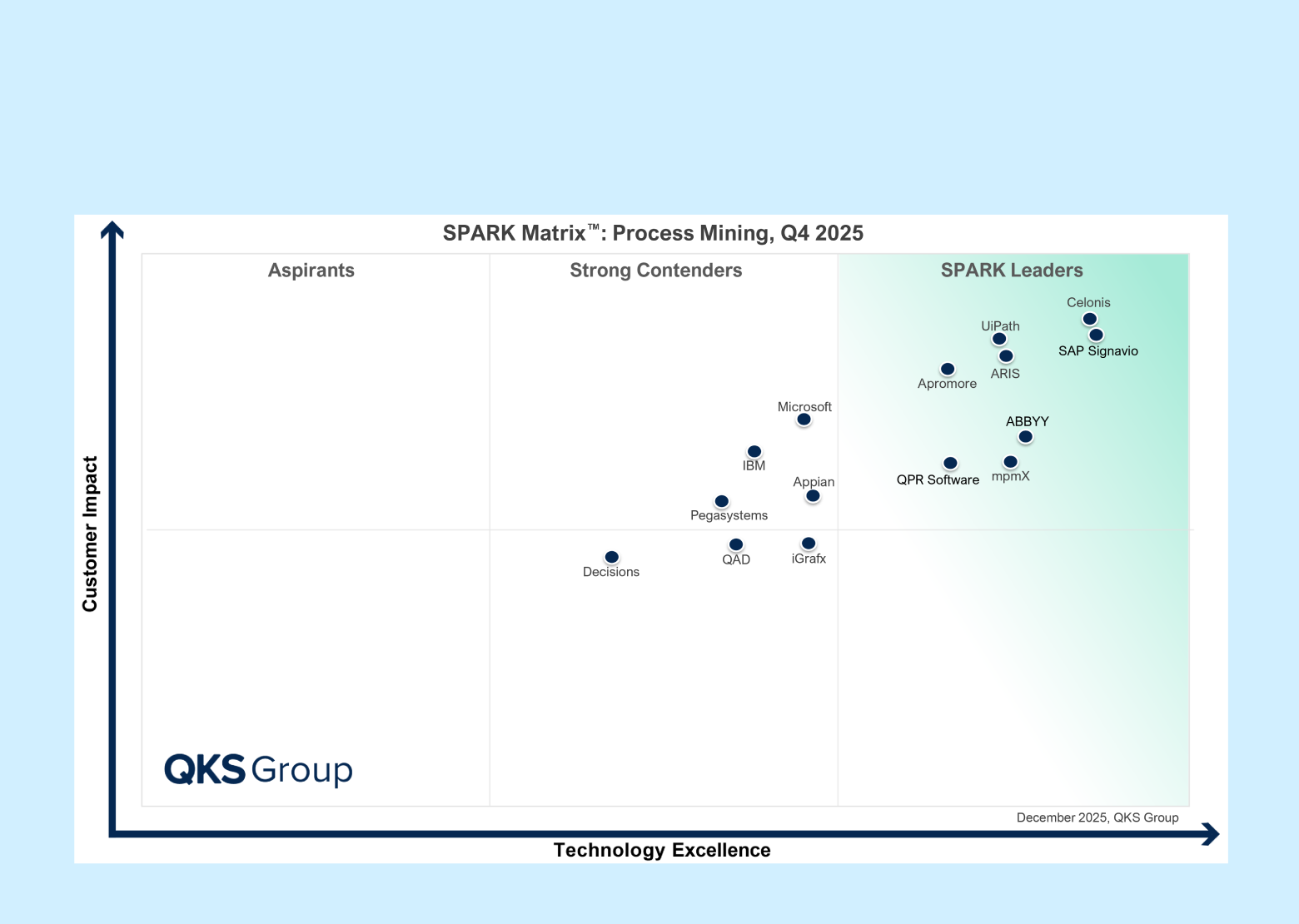
SAP Signavio Process Intelligence supports all the use cases described above through a single integrated product: event log extraction from SAP and non-SAP source systems (including SAP S/4HANA, SAP Ariba, SAP SuccessFactors, Salesforce, ServiceNow, and Oracle), process mining and discovery, BPMN 2.0 conformance checking, real-time monitoring, and simulation, all in one platform.
The process mining digital twin delivers significant operational value, but building and sustaining one requires attention to several recurring challenges:
The process mining digital twin runs as an ongoing operation, not a project with a defined end date. Organizations that treat it that way build the data infrastructure, governance model, and COE capability that lets improvement run continuously, rather than resetting after each project. Starting with a single, well-understood process and proving the data pipeline there is a more reliable way to scale than attempting multiple processes at once.
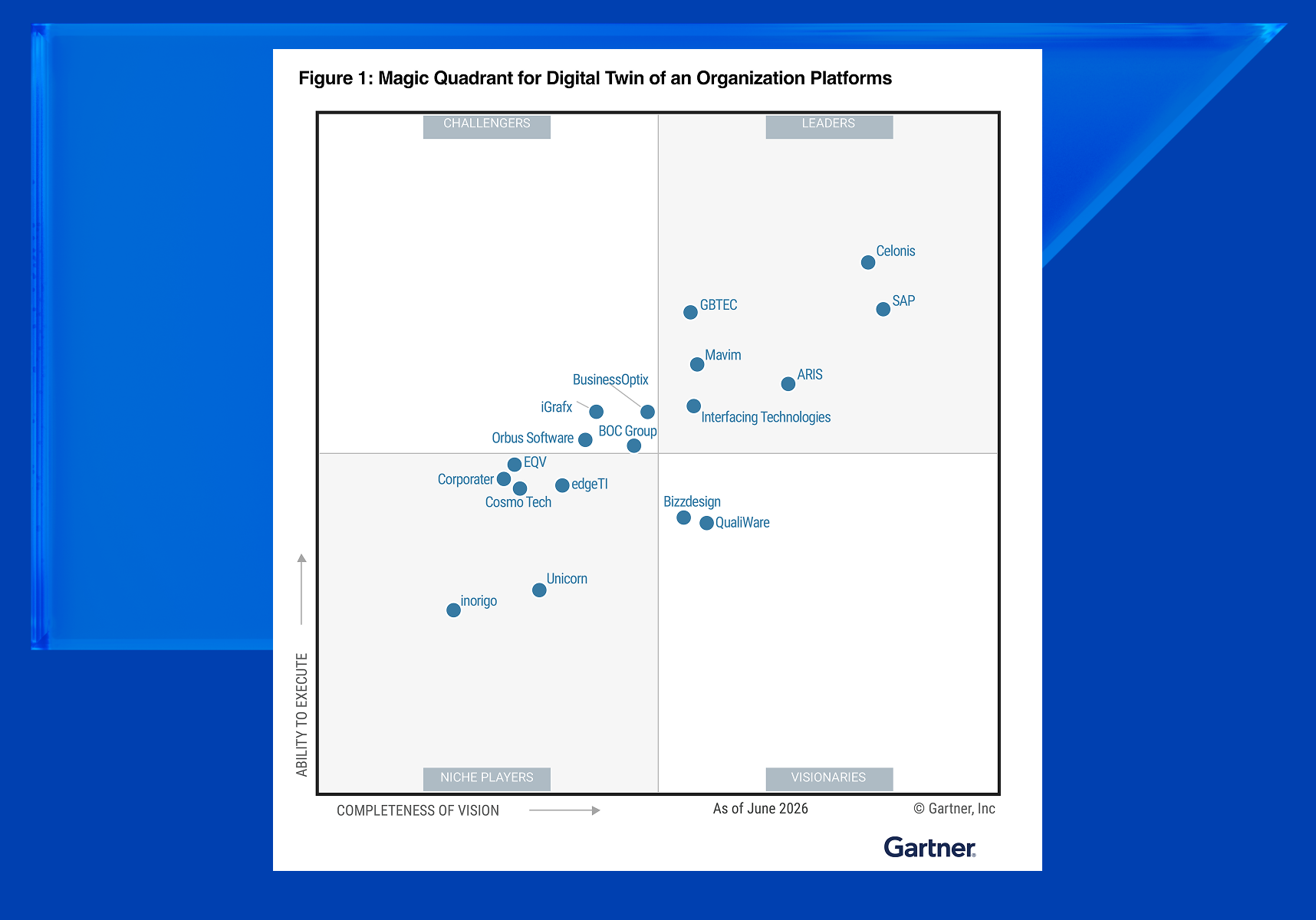
Download your complimentary copy of the report and see how SAP solutions were evaluated in this category.

Process mining is the analytical discipline of extracting process models from event log data. A process digital twin is the operational infrastructure that process mining creates and continuously updates, a live model of process execution that persists between analysis projects and keeps performance metrics current.

Gartner, Inc. Magic Quadrant for Digital Twin of an Organization Platforms. Marc Kerremans, David Sugden, etl. 27 July 2026.
Gartner and Magic Quadrant are trademarks of Gartner, Inc. and/or its affiliates.
Gartner does not endorse any company, vendor, product or service depicted in its publications, and does not advise technology users to select only those vendors with the highest ratings or other designation. Gartner publications consist of the opinions of Gartner's business and technology insights organization and should not be construed as statements of fact. Gartner disclaims all warranties, expressed or implied, with respect to this publication, including any warranties of merchantability or fitness for a particular purpose.