Digital Twin of an Organization
A digital twin of an organization is defined as a live, data-driven model of business processes used to simulate change and govern transformation.



A digital twin of an organization is defined as a live, data-driven model of business processes used to simulate change and govern transformation.
Most organizations run their transformation programs against a model of how things should work — not how they actually do. The digital twin of an organization closes that gap: a live process model built from enterprise system data, used to monitor performance, detect conformance failures, and test proposed changes before they go live.
A digital twin of an organization (DTO) is a live, software-based representation of an organization's processes, people, systems, and data flows, modeled as they operate, not as they were originally designed. The DTO continuously ingests operational data from enterprise systems, applies that data to an underlying process model, and produces an always-current picture of how work gets done across the business.
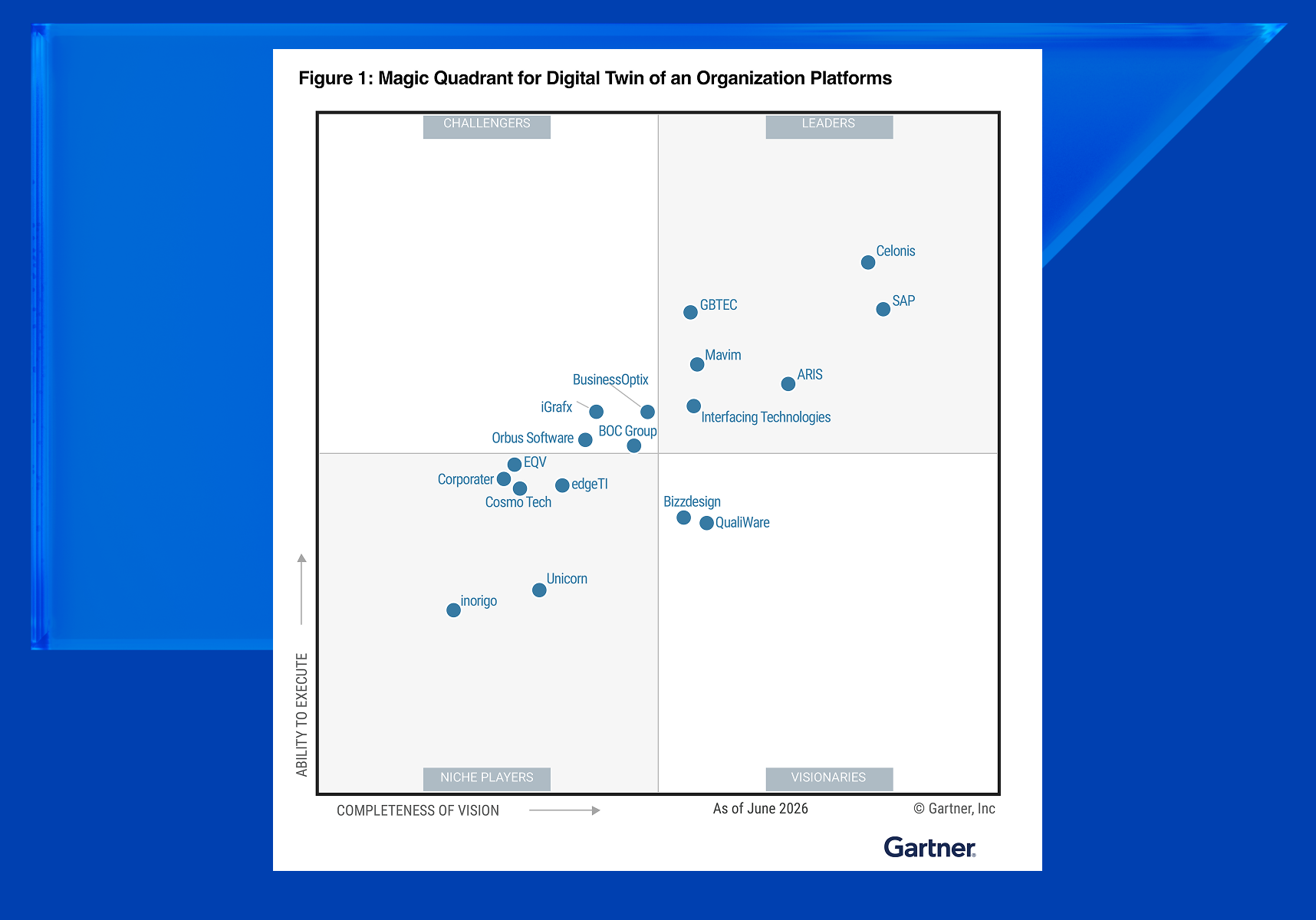
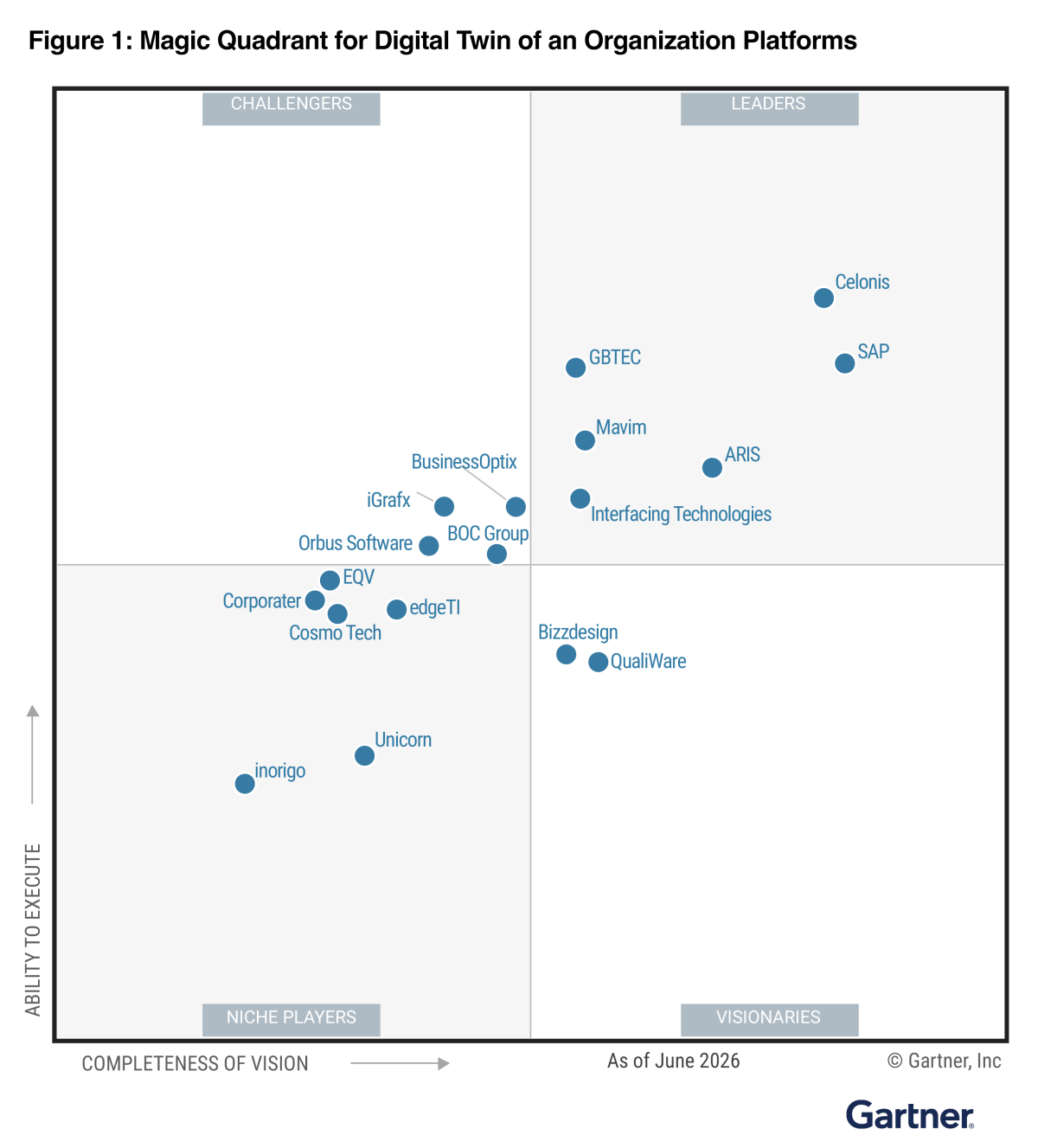
SAP is recognized as a Leader in the 2026 Gartner Magic Quadrant for Digital Twin of an Organization Platforms, the only vendor whose DTO natively combines process intelligence (SAP Signavio), enterprise architecture (SAP LeanIX), and an AI agent governance layer in a single closed-loop platform. The distinction from a static process map or a point-in-time audit is fundamental: a DTO does not describe how a process was designed to run; it shows how it is running right now, with the ability to test how changes would affect performance.
Most organizations have process documentation. The gap between that documentation and operational reality is where inefficiency, compliance risk, and transformation failure typically originate. A process digital twin closes that gap by connecting the process model directly to event log data from the systems executing those processes: SAP S/4HANA, SAP SuccessFactors, Salesforce, ServiceNow, or any system that records transactional events.
The result is not a model of the ideal process. It is a model of the actual process, enriched with performance data: cycle times, rework rates, conformance scores, variant distributions, and bottleneck locations. Teams can compare the designed state against the operational state and act on the difference.
A process-centric DTO is built from three layers working together:
Each layer depends on the others.
The business case for a DTO is grounded in the cost of process opacity. Organizations that lack a live view of how their processes perform make transformation decisions based on incomplete information, and the consequences show up in delayed projects, compliance failures, and efficiency programs that do not deliver expected returns.
The organizational digital twin directly addresses four operational challenges:
The return on a process digital twin is most directly measured in three areas: reduction in process cycle times, reduction in rework and exception handling costs, and acceleration of transformation programs. Organizations using process intelligence to underpin their DTO report faster identification of root causes for process failures, measured in hours rather than weeks, and stronger confidence in transformation decisions because the change has been tested before it is made. In one reported example, an aerospace company achieved a 20% improvement in cash flow process cycle time using the DTO.
The deeper shift is organizational: a DTO enables transformation to become a continuous capability rather than a periodic project. Where traditional improvement programs run in cycles (discover, redesign, implement, then wait for the next cycle), a DTO-backed organization maintains a live feedback loop between virtual simulation and real-world execution. Each cycle makes the model more accurate and the decisions faster.
Building and operating a process digital twin follows four distinct phases, beginning with process discovery. Each phase produces outputs that feed into the next, creating a cycle that keeps the twin current as business conditions and process execution change over time.
Process discovery is the foundation of the DTO. Process mining algorithms extract event log data from source systems, recording every case, activity, timestamp, and resource involved in executing a process. For a Procure-to-Pay process running on SAP S/4HANA, this means every purchase order, goods receipt, invoice, and payment event is recorded and structured into a complete process trace.
The output of process discovery is a data-driven process model: the actual path distribution of how the process runs, including all variants, deviations, and exceptions. This is not a workshop output or a documented procedure. It is derived directly from system data.
Discovery produces a data model of actual execution. Modeling applies structure to that data by mapping it to a BPMN framework, the standard notation for business process modeling. The BPMN model defines the expected process flow: the sequence of activities, decision points, roles, and handoffs that constitute the designed process.
With both the discovered and the designed model in place, the DTO can run conformance checking: a comparison that measures how closely actual execution matches the intended design. Conformance scores quantify deviation and identify where the process drifts from its documented version. These scores become the baseline against which improvement is measured.
Process simulation is the scenario-testing layer of the DTO. With a calibrated process model and real performance data as input, simulation allows teams to modify process parameters, such as removing a bottleneck activity, adding a parallel path, or changing a handoff rule, and observe the projected impact on cycle time, throughput, and resource utilization before any change is made in the live system.
This is the capability that distinguishes a DTO from a process analytics tool. Analytics describe what has happened. Simulation tests what could happen. For a finance transformation program planning to restructure the month-end close process, simulation answers the question: if we eliminate this manual reconciliation step, what is the projected reduction in close cycle time, and what is the risk of increased exception volume?
A DTO is not a one-time model. The value of the twin depends on its currency, and currency requires continuous data ingestion. Process monitoring connects the DTO to live system data on a continuous basis, updating process performance metrics in near real time and alerting teams when conformance drops below defined thresholds or when KPI targets are being missed.
Continuous monitoring shifts process management from reactive to proactive. Instead of discovering a process failure in a quarterly review, teams receive a signal when execution deviates from the defined path, with enough lead time to investigate and correct the root cause before it affects downstream outcomes.
The organizational digital twin has the broadest applicability in processes where operational complexity is high, cross-system data is distributed, and the cost of process failure is measurable in financial or compliance terms.
The month-end close is one of the most pressure-sensitive processes in any organization. It involves dozens of activities across accounting, treasury, and reporting functions, with a hard deadline and direct impact on financial reporting accuracy. A process digital twin built on event log data from SAP S/4HANA Finance gives the finance COE a complete view of how the close executes: where tasks are queued, which steps are running late, and where manual interventions are creating cycle time variation.
Simulation within the DTO allows the finance transformation team to model a restructured close, identifying which activities can run in parallel, which approvals can be automated, and what the projected impact is on days-to-close. Changes are validated in simulation before any live process is touched.
The Order-to-Cash process spans sales order entry, credit checks, fulfillment, invoicing, and collections, often across multiple systems and business units. In most organizations, no single team has visibility into the full process. Delays, rework, and payment disputes accumulate in the gaps between systems.
A process digital twin integrates event log data across the full O2C chain to surface cycle times by stage, variant distributions, and the specific activities where cases most frequently deviate from the optimal path. For a Head of Process Excellence managing an O2C improvement program, the DTO replaces hypothesis-driven analysis with evidence-based prioritization: fix these three variants, in this order, for this projected reduction in days sales outstanding.
Regulatory compliance in processes like Procure-to-Pay, HR, or financial controls requires that specific activities happen in a defined sequence, with defined approvals, every time. In practice, workarounds accumulate. Approvals are skipped. Exceptions become norms. By the time an internal audit or external regulator surfaces the finding, the deviation has been running for months.
Conformance checking within the DTO compares actual execution against the defined compliant path on a continuous basis. Deviations are flagged as they occur, not in the next audit cycle. This shifts compliance management from periodic sampling to continuous monitoring, reducing both the risk exposure and the cost of remediation.
The organizational digital twin creates value at three points in the process lifecycle: before a process is changed, while a process is running, and after a change has been made.
Before a change, the DTO provides the evidence base for transformation decisions, replacing internal workshops and consultant-led assessments with data derived directly from system execution. This reduces the cost and time required to diagnose a process problem and build the business case for improvement.
While processes are running, the DTO maintains a continuous operational picture, providing the process COE with performance KPIs, conformance scores, and variant analyses that replace lagged, aggregated reporting with near-real-time visibility.
After a change has been implemented, the DTO measures whether the change achieved its intended effect, comparing post-change execution data against the pre-change baseline and the simulation projection. This closes the transformation loop: changes are not just deployed, they are verified.
The cumulative business model is a shift from episodic process improvement, driven by annual programs or audit findings, to continuous process management, where the organization maintains a live view of operational performance and acts on deviations before they compound. SAP combines SAP Signavio Process Intelligence (process observability) with SAP LeanIX (technology landscape) to deliver enterprise-wide observability, connecting the process dimension and the technology dimension of transformation in a single continuous intelligence layer. SAP Signavio Process Intelligence provides the process mining, BPMN modeling, and simulation capabilities that make this model operational.
"The Process Mining & Insights feature is a standout for me, acting like a digital X-ray that identifies maverick processes, pinpoints bottlenecks, and even helps with benchmarking." — 5★ · G2
The governance layer for AI agents operating within these processes is structured through Process Atoms — machine-readable units that encode the behavioral rules governing each process step. Agents act within defined boundaries, and every autonomous action is auditable.
Building a process digital twin requires data, structure, and ongoing commitment. The most common challenges organizations encounter are:
A process digital twin is a commitment to running the business on evidence rather than assumption. Starting with a single high-value process and building outward is the most reliable path to that shift at scale.
SAP is recognized as a Leader in the 2026 Gartner Magic Quadrant for Digital Twin of an Organization Platforms. Download the report to see the full evaluation.

No. A process map documents how a process is designed to run. It is created once and updated manually when the process changes. A digital twin of an organization reflects how processes are running, updated continuously from live system data. The twin includes variant distributions, performance KPIs, and conformance scores that a process map cannot provide.

Gartner, Magic Quadrant for Digital Twin of an Organization Platforms, Marc Kerremans, David Sugden, et al. 27 July 2026.
GARTNER is a registered trademark and service mark of Gartner, Inc. and/or its affiliates in the U.S. and internationally, and MAGIC QUADRANT is a registered trademark of Gartner, Inc. and/or its affiliates and are used herein with permission. All rights reserved.
Gartner does not endorse any vendor, product or service depicted in its research publications, and does not advise technology users to select only those vendors with the highest ratings or other designation. Gartner research publications consist of the opinions of Gartner's research organization and should not be construed as statements of fact. Gartner disclaims all warranties, expressed or implied, with respect to this research, including any warranties of merchantability or fitness for a particular purpose.