Digital Twin Examples & Use Cases
Process digital twin examples include Order-to-Cash optimization, Procure-to-Pay compliance, finance close acceleration, and HR onboarding standardization.



Process digital twin examples include Order-to-Cash optimization, Procure-to-Pay compliance, finance close acceleration, and HR onboarding standardization.
The process digital twin delivers the most direct value in high-volume, cross-system transactional processes where execution data is abundant, performance KPIs are measurable, and the cost of process failure is visible in financial or compliance terms. The five examples below are the most common process transformation use cases for the DTO in practice.
The Order-to-Cash process (from sales order entry through credit check, fulfilment, invoicing, and payment collection) is one of the most revenue-sensitive processes in any organization. Delays at any stage affect days sales outstanding, customer satisfaction, and cash flow. In most organizations, no single team has end-to-end visibility into how O2C actually executes across all business units, customer segments, and transaction types.
Built on SAP S/4HANA and CRM event log data, the process digital twin gives the process excellence team a complete O2C picture: the actual path distribution across all variants, the cycle time at each step, the frequency of manual credit holds, and the percentage of invoices that require correction before payment. Conformance checking identifies where the process deviates from the intended flow: which activities are frequently skipped, which approvals are being bypassed, and which exception paths drive the longest cycle times.
In one pattern common across manufacturing environments, process teams discover that a significant share of orders route through a manual credit review not captured in the standard process design, and that this variant drives a disproportionate share of orders that exceed the target cycle time. Teams address this variant by working with the credit management function to automate low-risk credit checks. The cycle time impact falls without requiring a full process redesign.
Procure-to-Pay processes must comply with internal controls and external regulatory requirements around approval sequences, segregation of duties, and payment authorization. In organizations processing thousands of purchase orders per month, manual compliance monitoring through periodic audits cannot keep pace with the volume of transactions or the pace at which deviations accumulate.
The P2P twin, built on SAP Ariba and SAP S/4HANA event data, runs conformance checking continuously, comparing every purchase order, goods receipt, and invoice against the defined compliant path. Deviations surface as they occur: an invoice processed without a corresponding approved purchase order, a payment released without a three-way match, an approval bypassed by substituting a user who lacks the required authorization. Each deviation is flagged for investigation the same day, rather than discovered in the quarterly internal audit.
The shift from audit-cycle discovery to same-day detection is the core compliance value of the P2P twin. Continuous conformance monitoring eliminates the remediation backlog that builds up when deviations go undetected across audit cycles. Quarterly evidence-gathering gives way to a persistent, auditable conformance record.
HR onboarding processes are among the most variant-heavy in any organization. Countries have different legal requirements, business units have different systems access needs, and hiring manager behaviors vary by region. The result is high cycle time variation, an uneven new-hire experience, and compliance risk from incomplete documentation in regulated regions.
Built on SAP SuccessFactors event data, the onboarding twin maps the actual variant distribution: how many distinct paths exist, which are compliant with local legal requirements, which create delays in systems access provisioning, and which regional populations have the longest time-to-productivity. Simulation tests the impact of standardizing specific onboarding steps, for example moving to a single provisioning workflow for standard systems access, on cycle time and exception volume across regions.
The month-end close is a high-pressure, deadline-driven process that involves dozens of activities across accounting, treasury, intercompany reconciliation, and financial reporting. Delays in any step cascade into downstream delays, and the hard reporting deadline creates direct pressure on the process team to complete accurately and on time.
Built on SAP S/4HANA Finance event data, the close twin gives the finance COE a complete picture of close progress: which activities are on schedule, where tasks are queuing, which steps run consistently late, and where manual interventions create cycle time variation that standard procedures do not account for. Performance monitoring surfaces these patterns during the close itself, not in the post-mortem.
Simulation tests specific redesign scenarios: which activities can run in parallel rather than sequentially, which manual reconciliation steps can be automated for the standard case, and what the projected impact is on days-to-close. Shared services centers use the close DTO to identify sequential manual steps that can be parallelized. The projected cycle time reduction is validated in simulation before any change reaches the live process.
Customer service processes (inquiry, case routing, investigation, resolution, and closure) vary significantly across customer type, issue category, and channel. High average handle time, first-contact resolution failures, and repeat contacts typically trace to specific process variants that are inefficient or poorly routed. Without a process digital twin, identifying which variants are driving these outcomes requires manual analysis of case data that may not capture the full process path.
The customer service twin, built on ServiceNow or SAP Service Cloud event data, maps the full case lifecycle from first contact through resolution, including all routing decisions, escalations, and reopenings that make up the actual service process. Variant analysis identifies the case types and routing paths that account for the longest handle times and the highest re-contact rates. Simulation tests alternative routing rules and escalation thresholds before changes go live.
All five examples cover different process types and business units, but follow the same logic: a live process model, continuous data from source systems, and the ability to validate changes before deploying them. The same approach applies wherever process performance is measurable and the cost of change is high.
Across transformation programs, the process digital twin tends to address three types of business objective.
The process digital twin surfaces the specific process variants and bottlenecks that drive cycle time variance, rework, and exception handling cost. Rather than targeting improvement effort based on expert judgment or periodic assessments, process excellence teams use the twin to prioritize by quantified impact. Resources go to the variants with the highest volume and the largest cycle time deviation from the target path.
For regulated processes, the process digital twin shifts compliance management from periodic audit-based sampling to continuous conformance monitoring. The twin detects deviations from compliant paths as they occur. Same-day detection reduces both the exposure from undetected deviations and the cost of remediation before problems accumulate. At audit time, the twin provides a continuous evidence record (conformance scores, deviation logs, and remediation history) that replaces manual evidence gathering.
Organizations that need to change processes quickly, whether in response to regulatory updates, system migrations, or business model shifts, benefit from the twin's ability to compress the analysis and validation phases of process change. Because the twin maintains a current baseline and supports scenario simulation, current-state analysis and change validation can both complete in days rather than weeks. This shortens the decision timeline for transformation programs.
Industry context shapes how these objectives apply in practice, particularly in sectors where regulatory requirements are most demanding.
The use cases above apply across sectors, but industry-specific compliance requirements, data availability, and process priorities shape where digital twins return the clearest results. The three sectors below are where adoption is most concentrated.
Financial services organizations apply the process digital twin to finance operations: accounts payable, accounts receivable, financial controls, and regulatory reporting. Banks and insurers use P2P and O2C digital twins to manage compliance risk, reduce manual touchpoints in transaction processing, and accelerate reconciliation cycles. Regulatory pressure around financial controls, including SOX, DORA, and internal audit requirements, makes conformance monitoring a particularly high-value application in this sector.
Healthcare organizations use process digital twins for patient flow management and billing compliance. Patient flow twins, built on hospital information system event data, surface bottlenecks in admission, treatment, and discharge processes: where cases queue, which handoffs create delays, and where the clinical pathway diverges from operational reality. Billing process twins run conformance checking on claim preparation before submission. The result is lower denial rates and less rework.
Retail organizations use process digital twins for supply chain execution monitoring and returns processing optimization. Supply chain twins, built on SAP S/4HANA and logistics system event data, surface cycle time variance in order fulfilment, inventory replenishment, and supplier delivery processes. Returns process twins identify the processing paths with the longest resolution times and highest handling costs. Those paths are the typical starting point for customer experience improvement and cost reduction in reverse logistics.
A process digital twin implementation runs in three phases: process discovery, model validation, and operational monitoring. Each phase builds on the previous, taking the twin from a static as-is baseline to an active operational tool.
The first phase of a process digital twin implementation is process discovery: extracting event log data from source systems, running process mining algorithms, and producing the as-is process model that will form the baseline for all subsequent analysis and monitoring. For a single high-priority process with accessible event log data, this phase typically takes four to eight weeks, with the majority of time spent on data extraction, cleansing, and case identifier harmonization.
The output of Phase 1 is a discovered process model showing the actual path distribution, variant frequencies, and cycle time statistics for the process as it runs today. This baseline calibrates all subsequent improvement measurement and simulation.
With the discovered model in place, Phase 2 validates it against the designed process (the BPMN reference model), establishes conformance monitoring rules, and activates simulation capability. Conformance checking produces the initial gap analysis between how the process was designed and how it runs. That gap analysis is the starting point for improvement prioritization.
The simulation draws on real process data from Phase 1: cycle times, resource utilization, and variant frequencies set its parameters so that scenario projections reflect the actual process rather than theoretical assumptions. The first simulation scenarios typically test the highest-impact improvement opportunities identified in the conformance analysis.
Phase 3 establishes the twin as an operational tool rather than a project deliverable. Teams configure continuous monitoring rules to alert the process owner when KPI thresholds are breached or conformance scores fall below defined levels. The process model slots into the COE's governance process, updated when the designed process changes and reviewed when new improvement priorities emerge.
By Phase 3, the twin is no longer a project output. It is the operational infrastructure for continuous process management. The process stays visible between improvement programs, and every change action is measured against its intended outcome.
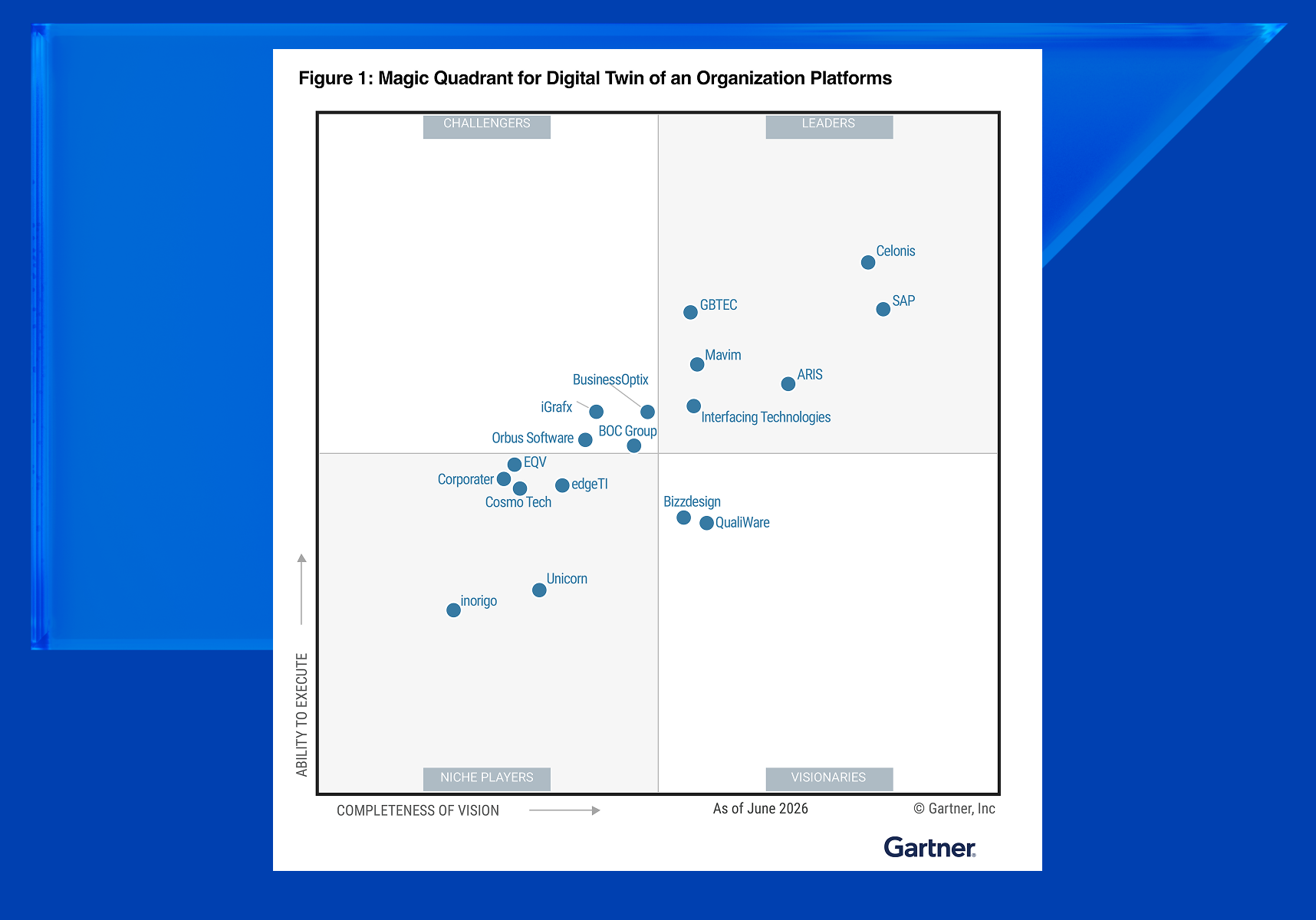
Download your complimentary copy of the report and see how SAP solutions were evaluated in this category.

Standard process mining is typically a project-based activity: a data extraction, a discovery analysis, a set of findings, and a recommendation report. A process digital twin extends this into a persistent operational capability: the mining infrastructure stays connected, the model updates continuously, and conformance monitoring runs between analysis projects. The examples on this page describe digital twin use cases (ongoing, operational process intelligence) rather than one-time mining projects.

Gartner, Inc. Magic Quadrant for Digital Twin of an Organization Platforms. Marc Kerremans, David Sugden, etl. 27 July 2026.
Gartner and Magic Quadrant are trademarks of Gartner, Inc. and/or its affiliates.
Gartner does not endorse any company, vendor, product or service depicted in its publications, and does not advise technology users to select only those vendors with the highest ratings or other designation. Gartner publications consist of the opinions of Gartner's business and technology insights organization and should not be construed as statements of fact. Gartner disclaims all warranties, expressed or implied, with respect to this publication, including any warranties of merchantability or fitness for a particular purpose.