BPM Governance
BPM governance is defined as the operating model for running a BPM program: who owns the function, how methodology standards are set, and how performance is reported.




BPM governance is defined as the operating model for running a BPM program: who owns the function, how methodology standards are set, and how performance is reported.
A business process management program is not self-sustaining. Without an explicit governance model, BPM initiatives follow the same arc regardless of quality: strong early momentum, gradual erosion as priorities shift, and eventual abandonment when no one owns the program mandate or methodology.
Governance is what prevents that arc. It defines how the BPM discipline operates as an organizational function, not just how individual processes are documented or improved.
BPM governance is the operating model that defines how an organization's business process management function is structured, resourced, and held accountable. It is distinct from process governance, which is concerned with how individual processes are owned, changed, and monitored. BPM governance is one level up: it governs the discipline itself.
The practical questions it answers are: Who mandates the BPM program and owns its budget? Who sets methodology standards for how processes are documented and approved? How are tooling decisions made and by whom? Who decides when the program scope expands or contracts? And how does the organization measure whether its investment in BPM is working?
Those questions are not answered by documenting a process or running a process mining analysis. They require a separate governance structure, operating at a different cadence and involving different stakeholders, from the program sponsor down to the CoE team. Organizations that treat BPM as a project rather than a governed function consistently struggle to sustain the gains they make in early improvement cycles.
The most common reason mature BPM initiatives stall is not technical failure. It is the absence of a clear mandate: no one at the executive level owns the program, the CoE has no authority to enforce standards, and the methodology drifts as teams adapt informally.
Governance is one of the strongest predictors of BPM program longevity. Organizations at lower BPM maturity levels typically have informal ownership and ad hoc standards; mature programs have documented methodology, an accountable sponsor, and a structured CoE. The gap between those two states is almost always a governance gap, not a capability gap.
The failure modes that a governance model addresses are predictable:
A governance model converts the BPM function from a project-based activity into a standing organizational capability.
The first structural decision in BPM governance is how the function is organized. Three models are in common use, and the right choice depends on the size of the organization, the number of business units in scope, and the degree of process standardization required.
A centralized Center of Excellence owns the BPM program, the methodology, and the tooling. Process owners across the business report into or collaborate with the CoE for all process documentation and improvement activity. This model works well in organizations where process standardization is a strategic priority and where the program needs a single authority to enforce consistent methodology.
The governance advantage of a centralized CoE is clarity of mandate. The CoE lead has a defined remit and the authority to reject process documentation that does not meet standards. The operational risk is that centralization slows adoption in business units that experience the CoE as a bottleneck rather than a partner, particularly in the first year of the program.
In a federated model, each major business unit maintains its own process excellence capability, and a central coordinating body sets standards and facilitates knowledge sharing across units. Tooling may be shared; methodology standards are set centrally but applied locally. This model suits large, diverse organizations where process landscapes differ significantly across business units or geographies.
The governance challenge in a federated model is standard enforcement. Without a central authority, methodology standards diverge as each unit adapts the framework to local context. Effective federation requires a strong standard-setting function, regular cross-unit governance reviews, and a central repository that makes divergence visible before it becomes entrenched.
The hybrid model is the most common structure in large enterprises. A central CoE owns the BPM methodology, tooling governance, and program reporting. Business units own their process portfolios and operate within the framework the CoE defines. The CoE's governance role is to set and enforce standards, not to own every process.
This model balances central authority with local ownership. The CoE is accountable for the quality and consistency of the methodology; business units are accountable for the performance of the processes they own within it. Both levels of accountability must be explicit, or the governance model collapses into neither: a CoE that sets standards no one follows, or business units acting without a methodology framework.
The choice between these models flows from BPM strategy: the operating model should reflect how widely the program intends to expand, which business units are in scope, and what level of standardization the organization can realistically achieve and sustain.
Governance accountability in a BPM program flows through four defined roles. The BPM team structure that supports these roles varies by operating model, but the accountability structure should be explicit regardless of program size.
Two distinct governance domains sit within the BPM function: methodology and tooling. Both require defined ownership, standards, and change control. Conflating them or leaving either ungoverned is one of the most common reasons scaled BPM programs lose coherence.
Methodology governance covers how processes are documented, modeled, and versioned within the program. It includes the notation standard (BPMN is the norm where conformance checking is required), documentation templates, naming conventions, granularity guidelines, and the approval workflow for new process types or patterns.
The CoE owns methodology governance and is the single authority for changes to the standard. When a business unit wants to introduce a new process type or documentation approach not covered by the existing framework, that request goes through the CoE. This prevents the methodology drift that erodes cross-unit comparability as programs scale.
Methodology governance also includes the publication workflow: who has authority to publish processes to the central repository as official governed versions, and what review steps are required before publication. Clear publication rights are the technical enforcement mechanism for the methodology standard, and defining them at program launch is significantly cheaper than retrofitting them after adoption has begun.
Tooling governance covers decisions about the BPM software selection used to run the program: which platforms are authorized, how access rights are structured, and who is accountable for maintaining the central process data model over time.
The key governance decisions in tooling are: who can create and modify processes in the repository, who has read-only access, and what approval is required to add a new tool or integration to the BPM technology stack. Tooling fragmentation is one of the most common governance failures in scaled BPM programs: when different teams use different modeling or mining tools, the program loses its ability to provide a consistent view of the process landscape to leadership or to the program sponsor.
Access rights in the process repository should mirror the accountability structure: process owners can propose and draft; the CoE approves and publishes. Contributors have read and comment access. Executive stakeholders have read-only access to dashboards and program reports. This structure is simple to define at program launch and becomes expensive to retrofit retroactively.
Process-level reporting covers cycle time, conformance rate, and deviation volume. BPM program reporting operates at a higher level: it tracks whether the BPM function itself is working and whether the organization's investment in the discipline is producing measurable outcomes.
Program reporting for BPM governance covers four areas.
BPM maturity assessment is not only a diagnostic tool; it is a governance input. Periodic assessments (annual or biannual) give the CoE lead and program sponsor a structured view of where the program stands against an external benchmark and where governance investment will have the most impact.
Governance gaps consistently appear as the primary bottleneck at maturity levels two and three. Moving from informal to structured governance is the highest-impact action for a BPM program at mid-maturity, and a maturity assessment makes that investment legible to leadership in a way that internal reporting alone cannot. It provides the external reference point that turns a CoE lead's recommendation into a funded decision.
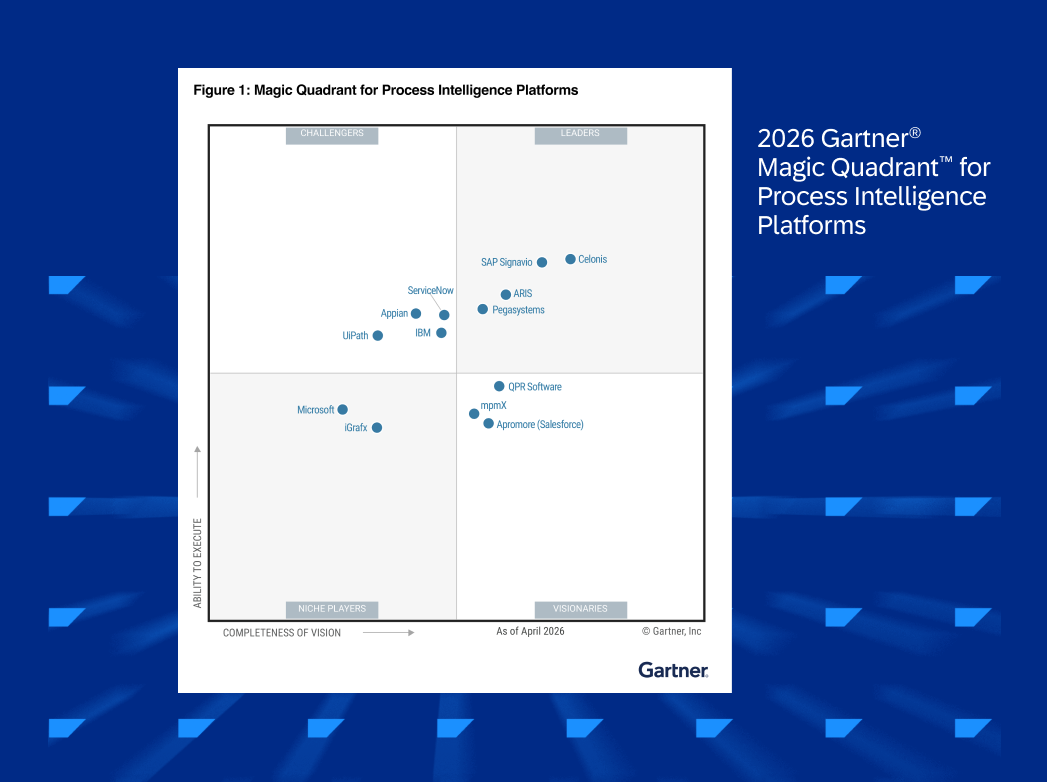
SAP Signavio provides the platform layer for governing the BPM function: a central process repository, structured access rights, and program-level reporting that turn governance from a policy document into an operational reality.
"It provides clear process visibility with intuitive modeling and collaboration tools, making it easy to analyze, optimize, and standardize business processes across teams."
A Forrester study on how organizations build durable process transformation capability — and what separates programs that sustain results from those that stall.

BPM governance manages the discipline: the CoE structure, the methodology, the tooling, and the program's accountability to leadership. Process governance manages individual processes: who owns them, how they are changed, and how conformance is monitored. Both are necessary, but they operate at different levels and involve different stakeholders. Governance of the BPM function is what makes process governance sustainable at scale.