Vendor evaluation: five criteria
The process intelligence market includes dozens of platforms, from narrowly focused process mining tools to full-stack process intelligence suites. Vendor selection comes down to five practical criteria. The criteria that predict production performance are different from the capabilities that look best in a demo. Evaluate each against your own process landscape, source systems, and scale requirements.
1. Data connector breadth and quality
The critical question is which systems a tool can extract data from, and how reliably, not which algorithms it offers. Prioritize vendors with native connectors for your core systems. Evaluate connector depth: does the connector pull raw event data from large ERP transaction systems, or does it surface pre-processed aggregates? For CRM connectors, does it capture full activity history or only standard objects? Shallow connectors produce shallow analysis.
2. Scalability for enterprise process volumes
A process mining pilot on a sample dataset will succeed with almost any tool. The question is whether the platform handles full production event log volumes, including hundreds of millions of events across multiple processes, without performance degradation. Ask vendors for reference customers running at your process scale.
3. Governance, security, and compliance
Process event data contains sensitive transactional information. Enterprise-grade tools provide role-based access controls, audit trails, data residency options, and versioning on process models and analysis results. For regulated industries, including financial services, pharmaceuticals, and healthcare, these are prerequisites, not nice-to-haves.
4. AI layer and improvement workflow
Check whether AI recommendations are built into the platform or bolt-on. Platforms that rank improvement opportunities by potential impact, and provide a workflow for tracking whether recommended changes were implemented and whether they worked, close the loop between insight and action. Without that closed loop, process mining remains a diagnostic tool rather than an improvement engine.
5. Integration with BPM and automation tools
Process mining finds what to fix. Acting on those findings typically requires a BPMN process modeling tool to redesign the process and an automation platform to execute changes. Tools that integrate with process design and automation capabilities, whether within the same product suite or via documented APIs, reduce the friction between finding an issue and resolving it.
Using analyst reports in vendor evaluation
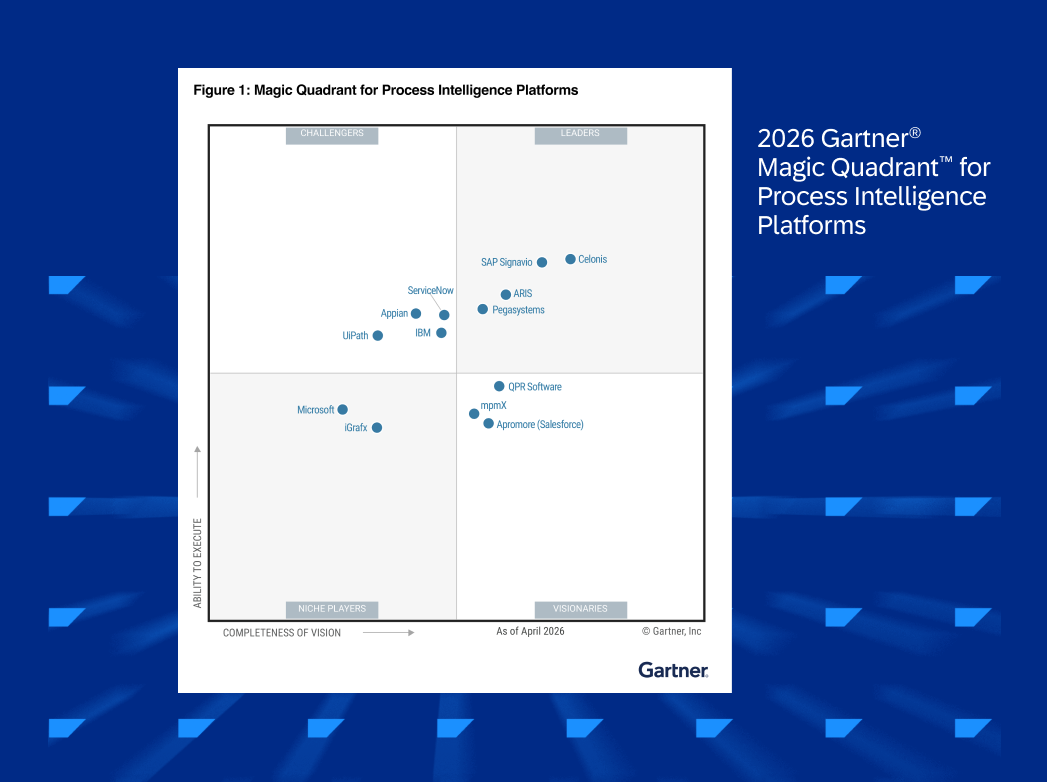
Independent analyst reports are a useful cross-check when narrowing a vendor shortlist. The 2026 Gartner® Magic Quadrant™ for Process Intelligence Platforms and the QKS Group SPARK Matrix for Process Mining are the two primary independent assessments of this market. Use them as one input alongside direct reference checks and proof-of-concept evaluations; neither replaces an assessment of fit to your specific source systems and process portfolio. A useful starting point for that assessment is understanding where process mining software sits relative to the analytics tools an organization already uses.
How it differs from business intelligence
Process mining software and business intelligence (BI) tools both work with enterprise data, but serve different purposes in the analytics stack. The distinction is in what question each answers and what data each analyzes.
|
Process mining software |
Business intelligence (BI) |
| Question answered |
Why did this outcome occur? |
What outcome occurred? |
| Data type |
Case-based event log data |
Aggregated dimensional data |
| Level of analysis |
Operational execution level |
Business outcome level |
| Output |
Process flows, variants, conformance gaps |
Dashboards, reports, KPI trends |
| Time orientation |
Traces execution sequences over time |
Aggregates metrics at a point in time |
| Example |
Why is the P2P cycle time 23 days instead of 8? |
P2P cycle time is 23 days |
The two are complementary. Business intelligence shows the outcome: a KPI is off track. Process mining identifies the process root cause: which variant, which approval path, which system handoff is responsible.