Process Discovery vs. Process Mining
Process discovery is the first stage of the BPM lifecycle used to understand how processes work. Process mining is one technique used during this stage to analyze system data.



Process discovery is the first stage of the BPM lifecycle used to understand how processes work. Process mining is one technique used during this stage to analyze system data.
Many people encounter the terms process discovery and process mining when researching how organizations analyze business processes. Because the two terms often appear together, they are sometimes mistaken as competing approaches.
In reality, they describe different levels of the same activity.
Process discovery is the broader stage in the business process management lifecycle. Its goal is to understand how work happens inside an organization. During this stage, teams identify activities, roles, systems, and handoffs involved in completing a process.
Organizations can use several techniques to perform process discovery. These include:
Each technique provides a different perspective on how work happens. Some rely on human knowledge and collaboration, while others rely on data from enterprise systems.
This is where process mining fits in. Instead of replacing process discovery, it provides a data-driven method for discovering how processes actually run in systems.
Understanding this relationship is important because many BPM initiatives start with the wrong assumption: that process mining and process discovery mean the same thing.
They do not.
Process discovery is the stage of the lifecycle, while process mining is one technique used within that stage.
Process discovery vs. process mining: key differences
Although the terms are often used together, process discovery and process mining serve different roles in business process management.
Process discovery is the broader lifecycle stage where organizations identify and document how a process works today. Process mining is a data-driven technique used within that stage to analyze how processes run in operational systems.
The following table summarizes the main differences.
| Aspect | Process discovery | Process mining |
|---|---|---|
| What it is | A stage in the BPM lifecycle focused on understanding how a process works today. | A technique used during process discovery to analyze how a process actually runs in systems. |
| Main purpose | Understand how a process works today across people, teams, and systems. | Analyze how the process actually runs in enterprise systems based on event data. |
| Primary input | Workshops, interviews, documentation, and system insights. | Event logs generated by enterprise systems. |
| Typical outputs | Process maps, journey maps, and current-state documentation. | Process flow visualizations, variants, bottlenecks, and performance insights. |
| Perspective | Combines human knowledge and operational understanding. | Focuses on system execution data and real process behavior. |
The key takeaway is simple:
Process discovery defines the goal—understanding how a process works. Process mining is one method used to achieve that goal using system data.
Process discovery is the first stage of the BPM lifecycle where organizations identify and document how a business process currently works.
The goal is to build a shared understanding of the current state before analyzing or improving the process. Teams examine how work flows through departments, systems, and customer interactions.
For example, a company trying to improve its employee onboarding process might begin with process discovery. HR, IT, and hiring managers document every step involved in onboarding a new employee, from signing the contract to receiving system access and completing training.
This stage often reveals important gaps such as:
Without this step, organizations risk redesigning processes based on assumptions rather than actual operations.
Process discovery creates the foundation for all later BPM activities.
Before organizations analyze performance or redesign workflows, they need a reliable picture of the current process reality. Employees often describe how processes should work rather than how they actually operate.
Process discovery aligns stakeholders around a single view of the process. This shared understanding helps teams identify improvement opportunities in later stages such as process analysis and process design.
Process discovery typically results in several artifacts that help organizations visualize how work flows through the business.
Common outputs include:
These outputs allow teams across the organization to discuss processes using the same structure and terminology.
In many organizations, process discovery combines human knowledge with system data. Workshops and interviews capture employee knowledge, while techniques such as process mining reveal patterns hidden in operational data.
Process mining is a data-driven technique used during process discovery to analyze how processes actually run in business systems. It uses event logs generated by enterprise applications to reconstruct real process flows.
Most modern business processes leave digital traces in systems such as ERP, CRM, or ticketing platforms. Each time an activity happens—such as creating an order, approving an invoice, or shipping a product—the system records a timestamped event.
Process mining tools analyze these event logs to automatically visualize the process and reveal how work flows across systems and teams. Instead of relying only on interviews or workshops, organizations can use data to see what actually happens in day-to-day operations.
This capability is particularly useful in complex environments where processes involve multiple systems, departments, and thousands of transactions. By analyzing system data, process mining can uncover patterns that are difficult to detect through manual discovery methods alone.
Process mining focuses on the execution data stored in business systems. The main inputs typically include:
Using these data points, process mining tools reconstruct the flow of activities for thousands or even millions of process instances.
Process mining can reveal operational patterns that are difficult to detect through workshops or documentation alone. Common insights include:
For example, a procurement team may believe that purchase orders follow a standard approval process. Process mining may reveal that in reality several variants exist, with some orders bypassing approvals or repeating review steps.
These insights help organizations validate assumptions made during process discovery and identify areas that require deeper analysis.
Process mining does not replace process discovery. Instead, it supports the discovery stage by providing objective data about process execution.
While workshops and process mapping capture employee knowledge, process mining shows how processes behave in systems. Combining both perspectives helps organizations build a more accurate picture of their current operations.
In many BPM initiatives, teams begin with workshops to understand the process structure and then use process mining to verify how the process actually runs in practice.
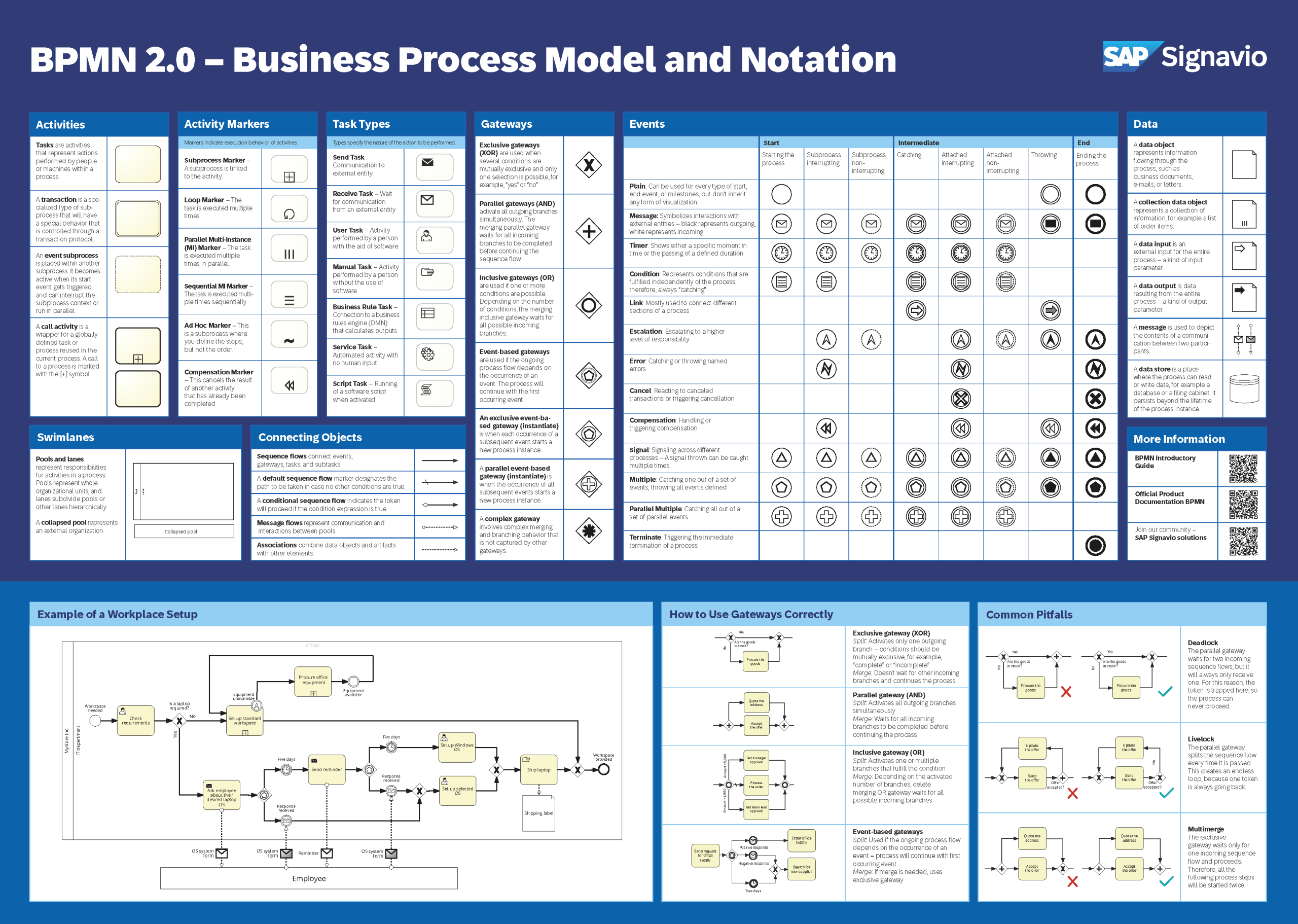
Get a BPMN 2.0 overview poster with the various graphical elements, examples of applications, and their meaning.