What is Company Memory?
Company memory is the governed, structured layer of procedural knowledge that captures how an organization makes decisions and executes work. Both humans and AI agents can query this layer at the point of execution.



Company memory is the governed, structured layer of procedural knowledge that captures how an organization makes decisions and executes work. Both humans and AI agents can query this layer at the point of execution.
Company memory is the structured, governed body of procedural knowledge that defines how an organization operates: how decisions are made, how exceptions are handled, what constitutes correct execution in a given process context, and why certain rules exist. This differs from factual knowledge about products, customers, or systems. Company memory captures the operational logic: the "how" of work, not just the "what."
In most organizations, this knowledge is fragmented across BPMN process models, policy documents, approval matrices, procedure manuals, and the tacit knowledge held by experienced employees. Much of it is never written down at all.
When people move on, when processes change, or when new systems are deployed, that knowledge is lost or becomes inconsistent across teams.
The practical consequence is process variation: the same process runs differently in different regions, teams, or time periods, not because the rules changed, but because knowledge of the rules was never captured in a form that could be consistently applied.
Company memory addresses this through a single, governed source of how the organization operates. Both human employees and AI agents can query it at the moment of execution.
A few adjacent terms overlap with company memory, sometimes used interchangeably.
That distinction, between knowing what exists and knowing how to act, is what makes company memory operationally urgent as AI agents take on more autonomous process decisions.
Process knowledge fragmentation has always been a management challenge. AI agents make it an operational risk.
In most enterprises, how a process should run is written down in many places at once: in BPMN models, in decision tables, in policy documents, in process mining data, and increasingly in the instructions given to AI agents. Each was authored separately, and none is the single source of truth. The result is execution drift: two teams handle the same case differently, a control everyone assumed was in force has lapsed in one process path, an agent does something technically permitted but not what anyone intended.
Business rules have not resolved this. A rule lives inside one system and captures one decision, so process knowledge stays fragmented regardless of how many rules are written. Rules are point-in-time: they evaluate a single condition, they cannot express behavior that unfolds over time, and they carry no native sense of context, scope, or goals. The same piece of logic ends up recreated in the rule engine, in the decision model, in the mining query, and in the agent configuration. These four artifacts drift apart the moment any one of them is updated.
When humans encounter an ambiguous situation in a process, they apply judgment: they escalate, ask a colleague, or default to what worked before. AI agents do not have that fallback. An agent handling an invoice approval, a procurement exception, or an onboarding workflow needs explicit context: which rule applies, under what conditions, and what counts as a violation. Without structured process knowledge, agents act on inference. The outputs may be locally coherent but organizationally incorrect.
Two categories of knowledge govern how agents should behave in process contexts:
Most enterprise AI implementations address semantic memory through retrieval-augmented generation and system integrations. Procedural memory, the layer governing how agents should behave in specific process contexts, is typically absent. Company memory addresses that gap.
Structured company memory operates through three stages.
Capture, govern, deliver: this three-stage structure separates structured company memory from a document repository or a knowledge base. The purpose is governance, not storage. Operational knowledge is kept current, consistent, and accessible when needed, and that consistency across agents, regions, and time periods is where the operational benefits become measurable.
When procedural knowledge is governed in a single authoritative layer, the benefits compound as more processes and agents reference the same source. These outcomes hold whether the process is human-executed, agent-executed, or both.
Realizing these benefits consistently depends on how well the implementation manages the organizational barriers that arise when formalizing knowledge that has always been informal.
Building and maintaining company memory requires sustained organizational investment. The most significant barriers are not technical: they arise because procedural knowledge has been held informally for so long that formalizing it involves real shifts in ownership and authority. Recognizing these barriers before starting reduces the most common failure modes.
Organizations that address these barriers before starting avoid the most common failure modes.
Implementations that hold up over time share a few structural principles. The right scope and governance structure from the start separate productive investments from unmaintainable libraries.
That parallel deployment is also where AI governance requirements become most immediate.
When agents expand from assistive tools into autonomous execution, handling more process steps and approval decisions, the quality of their outputs depends directly on the quality of the process context available to them.
An agent without access to company memory must infer how work should be done from general training and whatever system context it can retrieve. That inference may be accurate in common cases. It fails on edge cases, regulatory exceptions, and the accumulated institutional knowledge that makes a specific organization's processes function correctly.
Company memory provides the layer that makes agent behavior governable:
For organizations operating AI agents in compliance-sensitive processes such as financial controls or procurement approvals, this audit trail is the operational basis for demonstrating governance to regulators and internal risk functions.
In SAP Signavio, company memory is structured through Process Atoms — machine-readable knowledge units that encode operational logic in a form both humans and AI agents can query and act on.
Most organizations currently rely on a combination of tools where a dedicated company memory layer does not yet exist. Each has a defined scope, and each falls short of the full requirement.
Store process documentation for human reference and are widely used. They are not queryable by AI agents at runtime, not governed for consistency across versions or locations, and not executable. A process owner can look up a policy in Confluence; an agent executing that policy cannot verify against it.
Execute conditional logic reliably within a single system. The limitation is scope: BRMS are system-scoped, they do not carry process context or goals, and the same business logic must be recreated separately in each system that needs it. Two systems with related rules can drift apart after any update.
Agents can retrieve relevant text from process documentation using semantic search. Retrieval solves the query problem; it does not address the governance problem. Agents cannot verify behavioral compliance against retrieved text, cannot treat individual rules as versioned governed units, and cannot produce an audit trail that names which rule authorized a specific action.
Covers decision logic formally and with good tooling support. DMN is scoped to decision tables: it handles the conditional logic of a decision well but does not cover broader procedural flow, exception handling, or behavioral constraints that unfold across process steps. Company memory extends across decisions, exceptions, and behavioral constraints as a unified layer.
What most enterprises currently rely on. Each tool covers part of the problem: BRMS for system-level rules, document repositories for reference, RAG for retrieval, DMN for formal decision modeling. None provides a unified, governed, executable layer. This combination is the current-state reality that company memory is designed to replace.
No single existing tool covers the full scope. Most organizations currently rely on this combination; company memory consolidates what is currently fragmented across four or more overlapping tools.
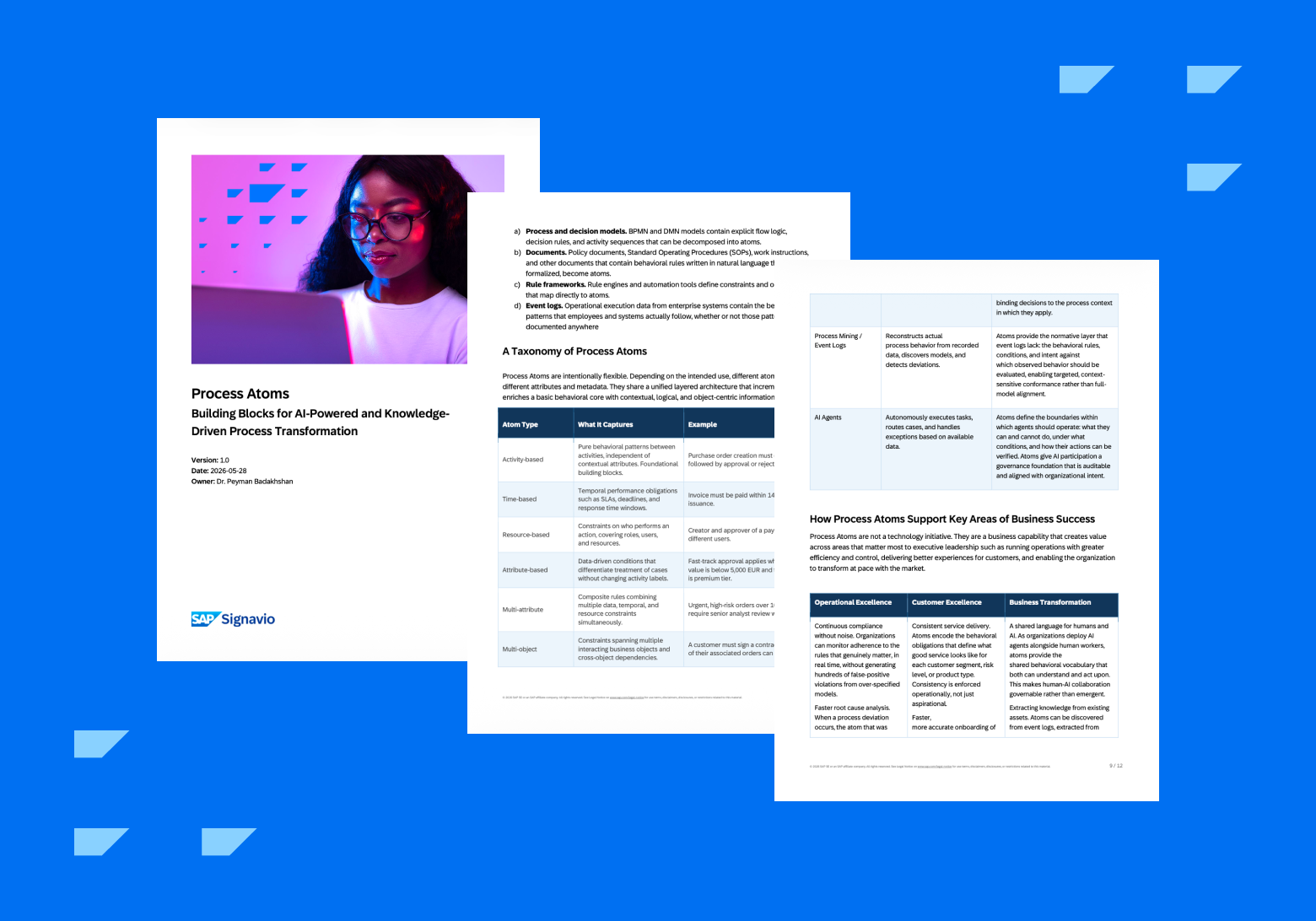
Discover how process atoms work as building blocks for AI-powered process transformation, governance, and continuous improvement.

A knowledge base stores documents, articles, and reference materials for retrieval. Company memory structures the procedural logic that governs how work is done (decision rules, exception paths, behavioral constraints) in a form that can be applied at runtime by AI agents and verified by conformance checking. The distinction is between storage for reference and governance for execution.