


At first blush, you may think that four transformations sounds like a lot. Well, it is! But it’s also not unusual. Indeed, the study on business transformation we published last year found companies undertake three transformations a year on average.
The point is, while people tend to think of transformations as projects that come along every once and a while, transformation is continuous. At any given moment, your organization most likely finds itself modernizing a critical enterprise system (such as your ERP), going through a post-merger integration, implementing a new operating framework, introducing new products and services, or expanding geographically.
And, of course, chances are that your company right at this minute finds itself wrestling with AI adoption and the broad range of organizational challenges that effort brings with it.
Business transformation: Perception vs. Reality
SAP commissioned Forrester to evaluate transformation readiness in companies today. To do that, Forrester conducted a global online survey with 1,007 VP-level-and-above decision-makers across Asia Pacific (APAC), EMEA, Latin America, and North America.
The findings reveal both a widespread confidence in the ability to transform as well as critical gaps in overall business transformation management practices.
For example, when asked about their top challenges when it comes to transformation, respondents indicated that they could execute transformations well within individual departments, but lacked an integrated, enterprise-wide strategy.
This lack was highlighted by other survey findings. For example, only 24% report having a cross-functional transformation governance board aligning business, process, people, and technology priorities.
What’s more, only 25% embed transformation goals in senior-leader KPIs and performance reviews and 26% say they maintain a roadmap for modernizing legacy systems and integrating emerging technologies.
Levels of transformation maturity
Given the continuous nature of transformation and the value of a holistic, organization-wide approach to transformation initiatives, we have been saying for a while now that companies need to treat transformation as a capability.
To understand the different dimensions of that capability, and to help business and IT leaders evaluate the maturity of this capability in their organization, the study looked at twenty-five factors across five areas: strategy and leadership, data, process, technology and applications, and people and culture.
As it turns out, when you look at the range of responses the study generated, it was possible to identify levels of maturity. It was also possible to show how companies at different levels of maturity differed from one another.
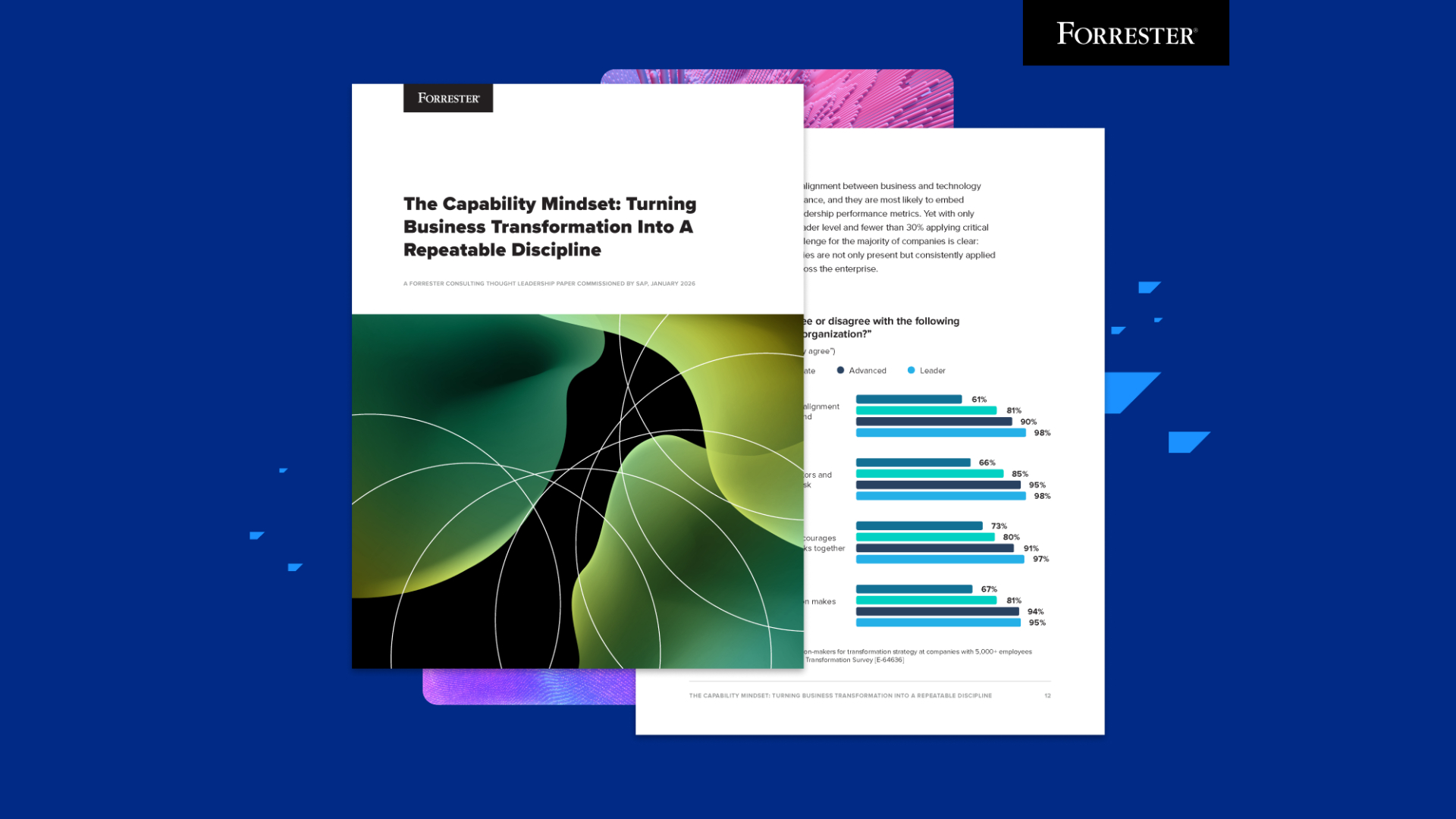
For example, 98% of leaders (representing 6% of companies surveyed) say, “Our EA practice ensures close alignment between our business needs and technological capabilities.” When you look at beginners (34% of respondents), that figure falls to 61%.
Similarly, 95% of leaders agree that, “Ongoing, widespread innovation makes my organization more resilient,” while only 65% of beginners do so.
Process issues get in the way of transformation
A full half of organizations surveyed struggle with challenges related to business processes and process management.
Specifically, half of respondents report misalignment between business process needs and IT capabilities. Half also report siloed ownership of key processes, which hinders coordination across the organization. Finally, half report the lack of real-time process performance monitoring.
Data issues are also a major issue for more than half of those surveyed. Fifty-six percent report poor data quality or inconsistent master data. And 55% report the prevalence of data silos.
The good news: the value of improved transformation management
Despite these challenges, there is a path forward. As the maturity curve indicates, some companies have successfully addressed these challenges and gotten better at transformation. What that calls for is a concerted effort to develop a transformation capability accounting for all transformation’s key dimensions.
And companies recognize the value of investing in this area. With a robust transformation capability in place, 68% expect an increased ability to pivot in response to market shifts or disruptions, 66% foresee faster upskilling and reskilling of their workforce, and 65% anticipate increased consistency and reliability in process execution.
On top of all that, 64% believe that increased transformation maturity will bring with it increased leadership alignment and accountability.
What now?
If you’ve read this far and want to dig more deeply into the study, we invite you to download a copy.
If you’ve heard enough and want to begin addressing the process side of business transformation, get in touch.
If you are not ready for either of those steps, I will leave you with this.
We have entered the era of AI. This technology is itself incredibly transformative and its impact is being felt at every level of every organization. But getting the most from AI itself demands transformation – of your processes, of your IT landscape, of your workforce.
And capitalizing on the opportunity presented by AI, today and into the future, calls for exactly what a robust transformation capability provides: a comprehensive view of your organization, reliable operational data, the ability to help employees quickly grow and adapt, and strong, strategic leadership.
In other words, for the foreseeable future, the ability to transform isn’t just another business capability, it’s the capability you and your business will need the most.